
Is Cisco Webex Calling right for a small Australian business?

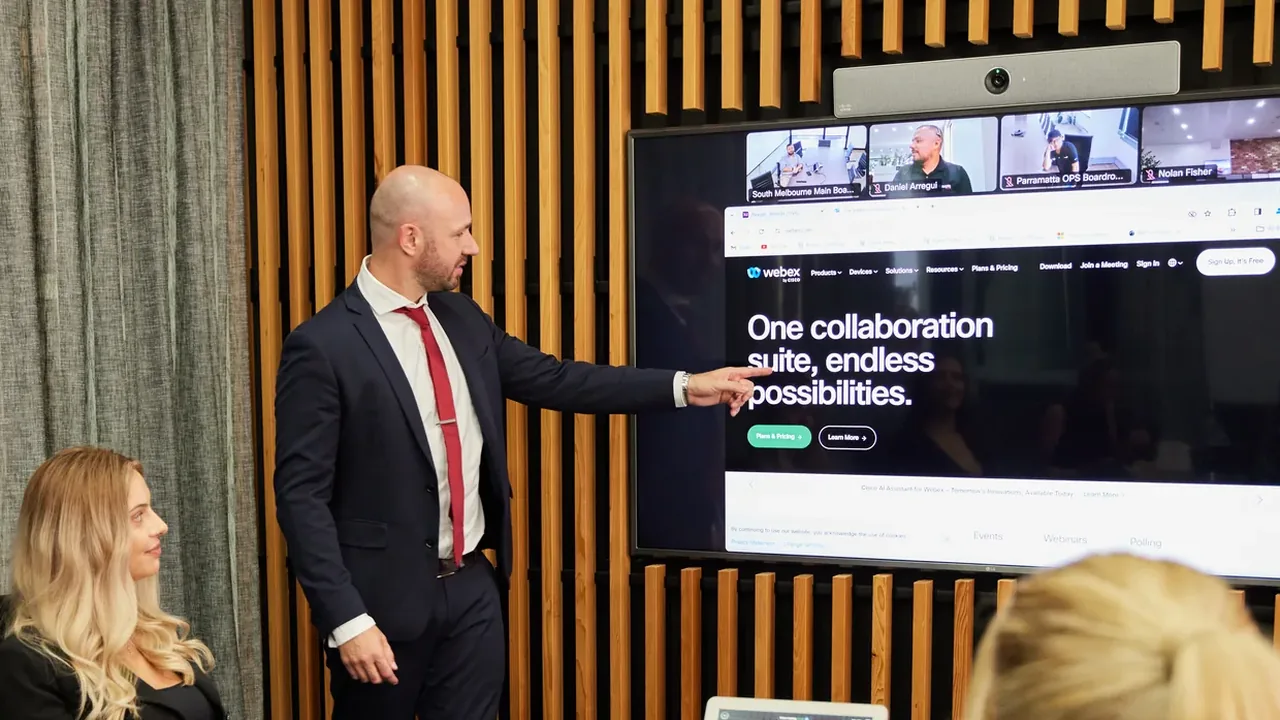
Cisco Webex Calling: a manager presents Webex on a boardroom screen

Cisco Webex Calling is a cloud phone system for businesses that want desk phones, the Webex App and centralised call management under one platform. For an Australian business with 3–20 handsets, it can be a strong fit when you need structured call handling, multiple locations or flexible user access—but it is not automatically the best choice for a very simple phone setup.

Webex Calling is best assessed as a platform choice, not just a handset replacement. The key questions are whether your staff will use its calling features, whether your network is ready for cloud voice, and whether your business is comfortable managing users, locations, devices and call flows through Cisco Control Hub.

If you are still comparing cloud phone platforms, start with this guide to what a cloud phone system is and how it works. This article focuses specifically on whether Webex Calling is suitable for your business.

What is Cisco Webex Calling?

Cisco Webex Calling is a cloud-based business calling service managed through Cisco Webex Control Hub. Users can make and receive business calls through supported desk phones, the Webex App and other supported devices, depending on the calling configuration assigned to them.

Cisco’s documentation describes Webex Calling as supporting common business telephony functions such as auto attendants, call queues, hunt groups, call pickup, call park, voicemail and call routing. These features are configured by administrators in Control Hub rather than through a traditional on-site phone system. Cisco’s Webex Calling configuration workflow sets out the main calling features and their intended uses.

For a small office, that means Webex Calling can go beyond a simple number that rings one handset. You can create a main-business-number menu, route calls to a group, let staff park calls for colleagues, and direct unanswered calls to voicemail or another destination.

The platform also supports multiple locations. Cisco states that locations can organise users and workspaces by physical site, with calling settings and administration managed through Control Hub. Cisco’s documentation on Webex Calling locations explains how users, workspaces and calling services are assigned to locations.

Who is Webex Calling best suited to?

Webex Calling is most suitable for a small business that wants more than basic inbound and outbound calling. It is particularly worth assessing where staff work across offices, use laptops or mobiles, or share responsibility for answering the main business number.

The strongest potential fit is a business with one or more of the following requirements:

A main number that needs an auto attendant or menu.
A receptionist, sales or service team that needs call queues or hunt groups.
Staff who need to answer business calls from the Webex App as well as a desk phone.
Multiple offices or work areas that need centralised administration.
A business already standardised on Cisco phones, Webex or Cisco networking.
Users who need call transfer, call park, voicemail, shared lines or business call handling.
A business that wants to manage calling users and devices through a cloud administration portal.

Webex Calling can also suit a business that wants to retain physical handsets while giving selected staff a softphone option. Cisco’s feature comparison for Webex App calling lists capabilities including calling phone numbers, call history synchronisation, call transfer, voicemail, call queues, hunt groups, call park and desk-phone calling for Webex Calling users. The supported calling options are documented by Cisco here.

For a 3–20 handset business, the value is usually in the call-handling design rather than the number of handsets alone. A five-person office with a shared reception number and an after-hours menu may have a stronger case than a 20-person office where every user only needs a direct number.

Who should not buy Webex Calling?

Webex Calling may be the wrong choice if your business only needs a basic phone line, has limited tolerance for configuration, or cannot provide a suitable network environment for cloud voice. A platform with many controls is not automatically better if your team will use only a small portion of it.

You should be cautious about choosing Webex Calling when:

You need only one or two simple numbers with no call routing.
Staff are unlikely to use the Webex App or any advanced calling features.
You want a phone system that requires almost no administration after installation.
Your internet connection is unreliable or poorly managed.
Your firewall, switching or Wi-Fi environment cannot be assessed and configured.
You rely on unsupported or ageing handsets and do not want to replace or reconfigure them.
You need highly specialised contact-centre functions rather than business telephony.
Your decision is based only on the Cisco brand rather than a documented fit with your call flows.

Webex Calling should also be treated carefully where the business has complex emergency-calling, compliance or site-specific requirements. Cisco’s feature tables include emergency-services location functionality, but the exact behaviour depends on the calling configuration, device type, location and local service arrangements. Those details should be verified for the proposed Australian deployment rather than assumed from a generic product description.

The practical test is simple: if your requirements can be written as a small number of clear call flows, Webex Calling may be suitable. If the business cannot explain who answers the main number, what happens after hours, or where calls should go when staff are busy, the platform should not be selected until those requirements are defined.

Is Webex Calling suitable for 3–20 handsets?

Yes, Webex Calling can be suitable for a 3–20 handset business, but handset count alone does not determine whether it is the right option. The decision should be based on users, locations, call flows, device requirements and the amount of administration your business is prepared to manage.

Business situation Likely fit for Webex Calling What to check before proceeding
One small office, direct calls only Possible but may be more platform than required Whether advanced features will actually be used
Small office with a shared main number Often a good fit Auto attendant, hunt group, queue and voicemail design
Reception or service team handling competing calls Stronger potential fit Queue behaviour, agent status and overflow routing
Several offices or distributed staff Potentially strong fit Locations, numbering, network paths and administration
Staff using desk phones and laptops Good fit if both experiences are required Webex App calling settings and supported devices
Existing Cisco Multiplatform Phones Potentially straightforward Model, hardware version, firmware and eligibility
Existing third-party phones Possible, but more limited Supported model, approval, provisioning and management limits
Business wanting almost no ongoing administration Weaker fit Who will manage users, numbers, devices and call features
Unreliable or unmanaged internet Poor fit until corrected Bandwidth, packet loss, latency, firewall and quality of service
Simple single-line calling only May be excessive Whether a simpler phone platform would meet the need

This is why a small business should not choose Webex Calling solely because it supports a particular number of users. A platform assessment should map the actual sites and handset count to the way calls enter, move through and leave the business.

What features does Webex Calling provide for a small office?

Webex Calling provides the core features most small offices expect from a modern business phone system, including call routing, voicemail, auto attendants, hunt groups, call queues and call park. The suitability of each feature depends on the selected licence, user configuration and deployment design.

An auto attendant can answer incoming calls, play menu options and route callers to a person, group or voicemail. Cisco documents support for business-hours schedules, after-hours menus, greetings and routing options in its auto attendant administration guide.

A hunt group can ring staff sequentially or simultaneously, depending on how the group is configured. A call queue is more appropriate when callers may need to wait for an available team member, with options such as greetings, comfort messages and music on hold. Cisco explains the distinction between these routing methods in its comparison of auto attendants, call queues, hunt groups and shared line groups.

Call park can be useful in offices where one person answers a call and another person retrieves it from a different handset. Call pickup can allow a team member to answer a colleague’s ringing phone, while voicemail groups can provide a shared mailbox for a department or workgroup.

These features are useful when they reflect a real operating process. They can create unnecessary complexity when a business has no receptionist, no shared answering responsibility and no need to route calls beyond individual users.

Can employees use Webex Calling without a desk phone?

Yes, Webex Calling can support users who make and receive business calls through the Webex App rather than a physical desk phone. Whether that is suitable depends on how your staff work and how the business wants users to handle calls.

The Webex App can provide business calling functions such as transferring calls, accessing voicemail, viewing call history, using call queues and handling calls from a computer. Cisco’s guide to managing phone calls in the Webex App describes the calling dock and common call controls available to Webex Calling users.

This can suit mobile office workers, managers who move between rooms, hybrid staff and employees who spend much of the day at a computer. It may be less suitable for staff who prefer a physical handset, work in noisy areas, share computers or need a dedicated phone at a reception or front counter.

The right design may be mixed: desk phones for reception and shared areas, with the Webex App for selected users. Do not assume every user needs the same device type. For guidance on handset selection, see how to choose the right business phone handsets.

What phones work with Webex Calling?

Webex Calling supports a range of Cisco Multiplatform Phones, Cisco desk phones, conference phones, DECT devices, Wi-Fi phones, analogue telephone adapters and selected third-party devices. Compatibility must be checked by exact model and, in some cases, hardware version or firmware.

Cisco’s supported devices list for Webex Calling includes multiple Cisco IP Phone families, Cisco Desk Phone 9800 Series devices, DECT handsets, conference phones and analogue telephone adapters. It also lists supported third-party devices, including selected Yealink and Poly models.

Existing phones should not be assumed to work simply because they are Cisco-branded. Cisco distinguishes between supported Multiplatform Phone models and other enterprise or legacy devices, and some third-party devices have more restricted provisioning and management capabilities.

Cisco also states that third-party device support can involve manual deployment, individual provisioning and limited configuration control through Control Hub. That makes an exact handset audit important before migration. Record the model, hardware version, firmware, location and intended user for every handset.

Does Webex Calling need a reliable internet connection?

Yes, Webex Calling depends on a properly configured network connection for signalling and voice media. Poor bandwidth, packet loss, latency, firewall configuration or quality-of-service settings can affect the calling experience.

Cisco recommends checking network bandwidth, quality of service, packet loss, round-trip time and required firewall ports before moving to Webex Calling. Its migration guidance for Webex Calling states that network readiness is a base requirement for a successful deployment.

The network review should cover each site, not just the head office. Check the internet service, firewall, switching, VLANs, Wi-Fi where relevant, traffic prioritisation and any remote-user connection method.

Cisco’s Webex Calling port reference explains that phones, the Webex App and gateways use defined signalling and media connections, and that correctly configured firewall and proxy rules are essential.

This is one of the most commonly missed parts of a small-business phone project. A cloud phone system does not remove the need for network planning; it moves the phone service onto the network your business already depends on.

How difficult is Webex Calling to administer?

Webex Calling is administered through Cisco Control Hub, where an administrator can manage users, locations, devices, phone numbers and calling features. That centralised model can be useful, but it still requires someone to understand the business’s call flows and maintain the configuration.

Cisco allows administrators to add users individually or in bulk and assign calling services through Control Hub. Its user-management documentation covers user setup, service licences, numbers and account administration.

For a small business, ongoing tasks may include:

Adding or removing users.
Assigning numbers and extensions.
Updating business-hours and holiday schedules.
Changing auto attendant greetings.
Adjusting hunt groups and call queues.
Managing handsets and Webex App access.
Reviewing device compatibility during staff or site changes.
Maintaining network and firewall settings.

This is manageable when responsibilities are clear. It becomes a poor fit when the business expects a phone system to run without an identified administrator, documented call flows or a process for handling staff changes.

How do Webex Calling licences affect the decision?

Webex Calling licences determine which users, devices and advanced features can be assigned, so licence selection should follow the required call flows rather than lead the decision. Exact entitlements and availability should be confirmed for the proposed deployment because features can vary by licence type and configuration.

For example, Cisco documents call queues as part of its Webex Calling professional capability and distinguishes them from more advanced Customer Assist functionality. Cisco’s call queue and Customer Assist comparison shows that the two options are intended for different levels of customer-call handling.

For a 3–20 handset business, prepare a user-and-feature schedule before reviewing Webex Calling licences:

Requirement Users or devices affected Licence question to confirm
Desk-phone calling Reception, staff or shared areas Which user or workspace entitlement is required?
Webex App calling Mobile or computer-based users Is full business calling enabled for each user?
Auto attendant Main business number Which licence or service supports the required menu?
Hunt group Small answering team Are all intended members eligible?
Call queue Reception, sales or service team Is the required queue capability included?
Shared voicemail Department or overflow calls What entitlement and configuration are required?
Multiple sites Users across locations How are locations and numbers assigned?
Existing third-party phones Selected handsets Are approval and manual provisioning required?

Do not compare Webex licence names in isolation. First document who needs a phone, who needs the Webex App, which numbers are shared, and what happens to unanswered calls.

What should an Australian SMB check before choosing Webex Calling?

An Australian SMB should validate the actual sites, handset models, internet connections, call flows, emergency-calling requirements and licence entitlements before committing. Product documentation alone cannot confirm that a proposed design will work for your specific offices.

Use this assessment checklist:

01SitesHow many physical locations will use the service?
02HandsetsWhat are the exact make, model, hardware version and firmware of each phone?
03UsersWhich people need desk phones, Webex App calling or both?
04NumbersWhich users need direct numbers, and which calls should use shared numbers?
05Call flowsWhat happens during business hours, after hours, holidays and busy periods?
06NetworkHas each site been checked for bandwidth, latency, packet loss, QoS and firewall requirements?
07AdministrationWho will manage users, numbers, devices and greetings?
08Emergency callingHow will location information and emergency-service requirements be handled for each site and user type?
09LicensingWhich Webex Calling licences and feature entitlements are required?
10FallbackWhat is the agreed process if a site loses internet access or a device fails?

If your business is already evaluating Cisco infrastructure, you can also review the broader Cisco business phone system options and Cisco cloud services. If your staff already live in Microsoft Teams, compare the workflow in Microsoft Teams Phone before selecting a platform.

Is Webex Calling worth considering for your business?

Webex Calling is worth considering when your business needs a structured cloud phone platform rather than a basic line-and-handset service. It is less compelling when the business has simple calling needs, limited network readiness or no appetite for ongoing administration.

The most reliable decision comes from testing the platform against your actual environment:

Your number of sites.
Your 3–20 handset count.
Your existing phone models.
Your staff’s use of desk phones and apps.
Your main-number and after-hours call flows.
Your network and firewall setup.
Your required Webex Calling licences and features.

Have the Cisco option assessed against your actual sites and handset count before you choose Webex Calling. That assessment should produce a clear recommendation: proceed, simplify the design, or consider a different platform.

Webex Calling FAQ

Is Webex Calling suitable for a three-person business?

It can be, particularly if the business needs a shared main number, call routing, mobile working or a mix of desk phones and the Webex App. If all three people only need basic direct calling, a simpler phone platform may be more appropriate.

Does Webex Calling require Cisco desk phones?

No, Webex Calling can also support the Webex App, selected third-party devices and other supported endpoints. Exact compatibility must be checked against Cisco’s current supported-device documentation before existing handsets are retained.

Is Webex Calling the same as having Webex Meetings?

No, Webex Calling is the business telephony service for calling phone numbers and managing phone-system features. A business should confirm which Webex services and calling capabilities are included in its proposed licence design.

Should a small business choose Webex Calling without a network assessment?

No, the network should be checked before deployment because Webex Calling relies on correctly configured internet connectivity, firewall rules and voice-quality conditions. Cisco specifically recommends validating network readiness, including bandwidth, quality of service, packet loss and latency.

Talk to Nexgen about your phone system

Get a like-for-like comparison against a managed cloud phone service.

Terms Of Use

Your access to the Nexgen website at https://www.nexgen.com.au is your acceptance of these Terms and Conditions and your access and use of the website is subject to these Terms and Conditions. If you do not accept these Terms and Conditions, you must refrain from using the Website. In these Terms and Conditions, capitalised words have special meanings. These special meanings are set out in the “General” section of this document.

Disclaimer of Liability – General Disclaimer

We are not liable to you or anyone else for any Loss in connection with use of this Website or a Linked Website or the failure to provide this Website.

This general disclaimer is not restricted or modified by any of the following specific warnings and disclaimers.

Disclaimer of Liability – Specific Warnings and Disclaimers

We are not liable to you or anyone else if interference with or damage to your computer systems occurs in connection with use of this Website or a Linked Website. You must take your own precautions to ensure that whatever you select for your use from this Website is free of viruses or anything else (such as worms or trojan horses) that may interfere with or damage the operations of your computer systems.

We may, from time to time, change or add to this Website (including these Terms and Conditions and privacy policy) or information, products or services without notice and your continued use of the Website will constitute acceptance of the variation. However, we do not undertake to keep this Website or these Terms and Conditions updated. We are not liable to you or anyone else if errors occur in the information on this Website or if that information is not up-to-date.

To the extent permitted by applicable law, all representations, warranties and other terms are excluded. You must ensure that your access to this Website is not illegal or prohibited by laws which apply to you or in your location.

To the extent permitted by applicable law, our liability for negligence, breach of contract or contravention of any law as a result of our failure to provide the Website, is limited to providing access to the Website.

You may not use the Website to collect or harvest Personal Information, including Internet addresses, about other users. You must comply with our Acceptable Use Policy available on the Website.

You must abide by any Terms and Conditions posted on the Website. You indemnify us from and against all actions, claims, suits, demands, liabilities, costs or expenses arising out of, or in any way connected to, the use of the Website by you.

Charges

You are responsible for the costs of all Internet access and telecommunications charges incurred when using the Website and accept that your use of the Website is your responsibility and is at your own risk entirely.

Nexgen operates secure servers to minimise the risk of unauthorised use of credit card information but unauthorised credit card use is at your risk.

Copyright

This Website, including without limitation, documents, information, programs and designs is our copyright property.

You are provided with access to it only for your personal and non-commercial use.

Other than for the purposes of and subject to the conditions prescribed under the Copyright Act 1968 (Commonwealth of Australia) and similar statutes that apply in your location, you may not, in any form or by any means:

1. adapt, reproduce, store, distribute, transmit, print, display, perform, publish or create derivative works from any part of this Website; or

2. commercialise any information, products or services obtained from any part of this Website, without our written permission.

Google Online Advertising

Nexgen use the Google AdWords Remarketing service which advertises across the internet to previous visitors to our website.

Google AdWords Remarketing displays relevant advertising content based on which sections of the Nexgen website you have visited. This is done by placing a cookie on your machine. A cookie is a small file sent to your browser from a web server to be stored on your computer. Cookies do not allow access to your computer or any data / files contained in your computer. It will not identify you in any way. Google Adwords Remarketing allow us to tailor our advertising and marketing content so it is relevant and suits your needs.

Any data collected as part of our use of Google Adwords Remarketing will be in accordance with Arrow’s privacy policy and Google’s privacy policy.

If you do not wish to be a part of our Google AdWords Remarketing, you can opt out by visiting Google Ads Preference Manager:

https://www.google.com/settings/ads

Then go to the “opt-out settings” where you can opt out of all interest based ads on Google and across the web.

Trade Marks

Intellectual Property in all materials, documents, information, data, images, logos and trade marks that we provide you or which are contained on the Website are owned or licensed to us and all rights are reserved.

Other product and company names mentioned in this Website may be the trade marks of other people or entities.

If you use any of our trade marks to refer to our activities, products or services, you must include a statement attributing that trade mark to us. You must not use any of our trade marks:

Linked Websites

This Website may contain links to Linked Websites. Those links are provided for convenience only and may not remain current or be maintained. We do not make any representation as to the accuracy or sustainability of any of the information contained on those other sites, and do not accept any responsibility or liability for the conduct or content of those other sites.

Links to those Linked Websites should not be construed as any endorsement, approval, recommendation, or preference by us of the owners or operators of the Sites, or for any information, products or services referred to on those Other Websites.

Unless stated otherwise on this Website, we have:

1. no relationship with the owners or operators of those Linked Websites; and

2. no control over or rights in those Linked Websites.

Personal Information

When transacting with you we may ask you for personal details such as your name, address and email address so that we can accurately identify who is using our services. By accessing the Website you consent to us sending you commercial electronic messages. If you do not want us to send you commercial electronic messages you may ask us not to by sending a blank email to [email protected]

Cookies

“Cookies” are a standard for storing small pieces of data on a web client (ie. the web browser on your computer). Any Web server (including this one) may:

1. store one or more cookies in your browser; or

2. request your browser to transmit the data to the Web server.

This Website may store cookies on your Web client in order to better serve you upon your subsequent visits to this Website.

By using cookies, Websites can track information about visitors’ usage of the site, provide customised content, or even the use of password protection. Note that some browsers can be configured to allow cookies to be accessed by servers other than the originating server.

Please note that most Web browsers can also be configured to notify the user when a cookie is received, allowing you to either accept or reject it. Please refer to the documentation and help screens for your web browser.

Security of Information

Unfortunately, no data transmission over the Internet can be guaranteed as totally secure. Whilst we strive to protect such information, we do not warrant and cannot ensure the security of any information or content which you transmit to us. Accordingly, any information which you transmit to us is transmitted at your own risk. Nevertheless, once we receive your transmission, we will take reasonable steps to preserve the security of such information.

Termination of Access

Access to this Website may be terminated at any time by us without notice. Our disclaimer will nevertheless survive any such termination.

General

In these Terms and Conditions:

1. “Intellectual Property” means any and all intellectual and industrial property rights throughout the world including but not limited to any copyright, trade mark, domain name, business name, design, patent, circuit layout, semi-conductor or other similar proprietary rights and licenses and sub-licenses of such rights (irrespective of whether or not such rights are registered, or formal or informal); trade secrets, technical or non-technical data, knowledge, information or documentation; secret or confidential operations or information; business systems, business methods or business plans (whether registered, formal, informal or otherwise); customer lists, supplier lists and other proprietary lists, names, addresses or information not generally known; techniques, diagrams, data, proofs, prints, particulars, inventions and prototypes.

2. “Linked Websites” means Websites of people other than NexGen which are hyperlinked from this Website.

3. “Loss” means any loss or damage, however caused (including through negligence) which may be directly or indirectly suffered.

4. “Personal Information” means any information from which your identity is apparent or can be reasonably ascertained as defined in the Privacy Act 1988 (Cth).

5. This “Website” means the whole or any part of the web pages located at https://www.nexgen.com.au (including the layout of this Website; individual elements of the Website design; underlying code elements of this Website; or text, sounds, graphics, animated elements or any other content of this Website).

6. “We” and “us” refer to Nexgen Australia Group Pty Ltd trading Nexgen Australiaas and “our” has a similar meaning.

These Terms and Conditions are governed by the laws in force in New South Wales, Australia and you submit to the non-exclusive jurisdiction of the courts of New South Wales, Australia and any courts which may hear appeals from those courts in respect of any proceedings in connection with these Terms and Conditions or this Website.

Nothing contained in these Terms and Conditions derogates from Nexgen’s right to comply with law enforcement requests or requirements relating to your use of this Website or information provided to or gathered by Nexgen with respect to that use.

Nexgen Master Security License Certificate Number is 410 295 251, ID Number 108 216 452 Nexgen is a member of ASIAL.

Privacy Policy

  • 1. About this Document
    • 1.1 This document (“Privacy Policy”) sets out the policy of Nexgen Investment Group Pty Ltd Trading As Nexgen Australia – ABN 88 606 251 503 in respect of the treatment of your Personal Information or your affairs or personal particulars.
  • 2. Interaction with Telecommunications Act 1997 (Cth)
    • 2.1 Nexgen is a Carriage Service Provider and is subject to obligations set out in the Telecommunications Act 1997 (Cth)
    • 2.2 To the extent that any of your Personal Information is also information of the kind referred to section 276 of the Telecommunications Act 1997 (Cth) (in particular, information that relates to your affairs or personal particulars) Nexgen will not use or disclose that information unless permitted by the Telecommunications Act 1997 (Cth) and the Privacy Act 1988 (Cth).
  • 3. Dictionary
    • 3.1 To assist in the understanding of this Privacy Policy, the following capitalized words in this Privacy Policy have the following meanings:
      Carriage Services has the meaning given to that term in the Telecommunications Act 1997 (Cth).
      Carriage Service Provider has the meaning given to that term in the Telecommunications Act 1997 (Cth).
      Personal Information has the meaning given to that term in the Privacy Act 1988 (Cth).
      Related Body Corporate has the meaning given to that term in the Privacy Act 1988 (Cth).
      Sensitive Information has the meaning given to that term in the Privacy Act 1988 (Cth).
      and includes information as to race, political opinion, religious believes, sexual preferences and membership of a professional or trade association.
  • 4. Collection
    • 4.1 1 Nexgen will collect Personal Information from you if that Personal Information is necessary for one or more of Nexgen’s functions or activities.
    • 4.2 Personal Information is predominantly collected so that Nexgen can supply Carriage Services to you (or contact you in respect of a proposed supply of Carriage Services) and perform ancillary and incidental functions. This includes:
      • customer service;
      • complaints handling;
      • billing; and
      • promoting our special offers as well as offers from our Related Bodies Corporate, suppliers and/or affiliated third parties.
    • 4.3 Nexgen may collect Personal Information using several different methods. For example, Personal Information may be collected by Nexgen:
      • directly from you by telephone, email or by completing a form (e.g. Nexgen may be provided with Personal Information on a customer application form, during contractual negotiations, during voice verification etc.); or
      • from third parties such as our Related Bodies Corporate, credit reporting agencies or your representatives; or
      • from information in the public domain – however if it is reasonable and practicable to do so, we will only collected Personal Information about you directly from you.
    • 4.4 Nexgen will take reasonable steps to ensure that you are aware at the time of collection (if practicable):
      • that Nexgen is collecting the Personal Information and as to how to contact Nexgen (if this is not obvious to you);
      • that you may gain access to the Personal Information (see paragraph 9 below);
      • the purpose for which the Personal Information is collected (this may be referring you to this Privacy Policy); done by
      • of the organisations (or types of organisations) to which Nexgen usually discloses Personal Information (this may be done by referring you to this Privacy Policy);
      • of any law that requires the Personal Information to be collected (for example, for compliance with the laws relating to the Integrated Public Number Database); and
      • of the consequences (if any) of Nexgen not collecting the Personal Information (typically, this will be an inability to supply Carriage Services to you).
    • 4.5 If it is not practicable for Nexgen to take reasonable steps to ma e you aware of the matters set out in paragraph 4.4 at the time of collection, Nexgen will do so as soon as practicable after collection.
  • 5. Use and Disclosure
    • 5.1 Nexgen will generally only use Personal Information for the primary purpose for which it was collected (for example, Personal Information set out in a customer application form is collected for Nexgen). the primary purpose of facilitating the supply of Carriage Services by
    • 5.2 However, Nexgen may use or disclose Personal Information for a secondary purpose in the following circumstances:
      Reasonable Expectation
    • 5.3 Nexgen may use or disclose Personal Information for a secondary purpose if:
      • the secondary purpose is related to (or if the Personal Information is Information, directly related to) the primary purpose of collection; and Sensitive
      • you would reasonably expect Nexgen use or disclose the Personal Information for that purpose.
    • 5.4 For example, Nexgen considers that if you are a customer, you would reasonably expect Nexgen to disclose or use your Personal Information to:
      • its printing and mailing house to print and dispatch correspondence and communications to you or
      • notify the customer of special offers or promotions from Nexgen, its Related Bodies Corporate, suppliers and/or affiliated third parties; or
      • ask you to participate in a customer satisfaction survey; or
      • to its dealers, sub-contractors and agents to enable them to perform certain functions on behalf of Nexgen.
  • Consent
    • 5.5 5 Nexgen may use or disclose Personal Information for a secondary purpose if you provide your express consent or consent can be implied.
    • 5.6 Nexgen may seek your consent on an application form for services, during the voice contracting stage of your application or in some other way.
  • Direct Marketing
    • 5.7 Nexgen may use or disclose Personal Information for the secondary purpose of direct marketing.
    • 5.8 Unless paragraphs 5.3 to 5.6 allow Nexgen to otherwise use Personal Information for direct marketing, Nexgen will only use Personal Information for direct marketing to you if:
      • it is not Sensitive Information;
      • it is impracticable for Nexgen to seek your consent before that particular use;
      • Nexgen will not charge you for giving effect to a request by you to not receive direct marketing communications;
      • you have not made a request to Nexgen not to receive direct marketing communications;
      • in each direct marketing communication with you, Nexgen draws to your attention, or prominently displays a notice, that you may express a wish not to receive any further direct marketing communications; and
      • each written direct marketing communication by Nexgen with you sets out Nexgen’s business address and telephone number and, if the communication is made by fax, telex or other electronic means, a number or address at which Nexgen can be directly contacted electronically.
    • 5.9 To avoid doubt, Nexgen will also comply with the Spam Act 2001 (Cth) and Do Not Call Register Act 2006 (Cth) in circumstances of direct marketing to you.
  • Life, Health and Safety
    • 5.10 Nexgen may use or disclose Personal Information if Nexgen reasonably believes that it is necessary to lessen or prevent:
      • a serious and imminent threat to an individual’s life, health or safety; or
      • a serious threat to public health or public safety.
  • Unlawful Activity
    • 5.11 Nexgen may use or disclose Personal Information if Nexgen has reason to suspect that unlawful activity has been, is being, or may be engaged in. However, Nexgen’s use or disclosure will be limited to that which is a necessary part of Nexgen’s investigation into the matter or in reporting Nexgen’s concerns to relevant persons or authorities.
  • Permitted by Law
    • 5.12 Nexgen may use or disclose Personal Information if Nexgen is permitted by law to do so. For example, Nexgen may disclose your Personal Information pursuant to:
      • a law enforcement request;
      • ccourt order or subpoena; or
      • its interception obligations.
  • Disclosure to Enforcement Body
    • 5.13 Nexgen may use or disclose Personal Information if Nexgen is permitted by law to do so. For example, Nexgen may disclose your Personal Information pursuant to an enforcement body (for example, the Australian Federal Police, ASIC, ACCC, police force etc.) if Nexgen believes that it is reasonably necessary for:
      • the prevention, detection, investigation, prosecution or punishment of criminal offences, breaches of a law imposing a penalty or sanction or breaches of a prescribed law;
      • the enforcement of laws relating to the confiscation of the proceeds of crime;
      • the protection of the public revenue;
      • the prevention, detection, investigation or remedying of seriously improper conduct or prescribed conduct; or
      • the preparation for, or conduct of, proceedings before any court or tribunal, or implementation of the orders of a court or tribunal.
  • 6. Data Quality
    • 6.1 Nexgen will review, on a regular and ongoing basis, its collection and storage practices to ascertain how improvements to accuracy can be achieved.
    • 6.2 Nexgen will also take reasonable steps to make sure that the Personal Information collected, used or disclosed is accurate, complete and current.
  • 7. Data Security
    • 7.1 Nexgen will take reasonable steps to protect the Personal Information it holds from misuse and loss and from unauthorised access, modification or disclosure. It will generally do so by:
      • restricting or limiting the access to Personal Information to those of its employees, agents or contractors who have a ‘need to know’;
      • removing access from employees, agents or contractors who no longer work for or with Nexgen or no longer have a ‘need to know’;
      • reviewing and resetting passwords which provide access to Personal Information with reasonable frequency; and
      • implement enhanced security access features to prevent unauthorised access, use or disclosure.
    • 7.2 Nexgen will take reasonable steps to destroy or permanently de-identify Personal Information if it is no longer needed for any purpose for which the Personal Information may be used or disclosed.
  • 8. Openness
    • 8.1 The Nexgen website will contain a prominently displayed link to this Privacy Statement.
    • 8.2 Nexgen will refer any person to this Privacy Statement if that person requests information on Nexgen’s policy on the management of Personal Information.
    • 8.3 On request by a person, Nexgen will take reasonable steps to let the person know, in general terms, what sort of Personal Information is held and the reasons for which that Personal Information is generally collected. Nexgen will also provide information, in general terms, in respect of how Nexgen holds, uses and discloses that Personal Information.
  • 9. Access and Correction
    • 9.1 1 If Nexgen holds your Personal Information, Nexgen will provide you with access on request to that Personal Information, in particular, so that you can verify the Personal Information is accurate, complete and current. If the Personal Information is not accurate, complete or current, Nexgen will take reasonable steps to remedy the inaccurate, incomplete or outdated Personal Information.
    • 9.2 However, Nexgen will not provide you with access to the extent that:
      • providing access would pose a serious and imminent threat to the life or health of any person; or
      • providing access would have an unreasonable impact upon the privacy of any other person; or
      • the request for access is frivolous or vexatious; or
      • the Personal Information relates to existing or anticipated legal proceedings between Nexgen and yourself, and the Personal Information would not be accessible by the process of discovery in those proceedings; or
      • providing access would reveal Nexgen’s intentions in relation to negotiations with you in such a way as to prejudice those negotiations; or
      • providing access would be unlawful; or
      • denying access is required or authorised by or under law; or
      • providing access activity; or would be likely to prejudice an investigation of possible unlawful
      • providing access would be likely to prejudice:
        • the prevention, detection, investigation, prosecution or punishment of criminal offences, breaches of a law imposing a penalty or sanction or breaches of a prescribed law; or
        • the enforcement of laws relating to the confiscation of the proceeds of crime; or a prescribed law; or
        • the protection of the public revenue; or
        • the prevention, detection, investigation or remedying of seriously improper conduct or prescribed conduct; or
        • the preparation for, or conduct of, proceedings before any court or tribunal, or implementation of its orders; by or on behalf of an enforcement body; or
      • an enforcement body performing a lawful security function asks Nexgen not to provide access to the information on the basis that providing access would be likely to cause damage to the security of Australia.
    • 9.3 Additionally, if providing access would reveal evaluative information generated within Nexgen in connection with a commercially sensitive decision-making process, Nexgen may give you an explanation for the commercially sensitive decision rather than direct access to the information.
    • 9.4 Nexgen reserves the right to charge a fee for searching for and providing access to your Personal Information (except if any other law prohibits Nexgen from charging a fee). In any event,
  • 10. Anonymous Transactions
    • 10.1 Nexgen will allow its customers to transact with it anonymously wherever that is reasonable and practicable.
  • 11. Transferring Personal Information Overseas11.1 Nexgen may transfer Personal Information outside of Australia where Nexgen considers that it is necessary or desirable to do so. However, Nexgen will not transfer your Personal Information outside of Australia unless any of the following circumstances exist:
    • Nexgen reasonably believes that the recipient of the Personal Information is subject to a law, binding scheme or contract which effectively upholds principles for fair handling of the information that are substantially similar to the National Privacy Principles contained in the Privacy Act 1988 (Cth); or
    • you consent to the transfer; or
    • the transfer is necessary for the performance of a contract between Nexgen and yourself, or for the implementation of pre-contractual measures taken in response to the your request; or
    • the transfer is necessary for the conclusion or performance of a contract concluded in your interest between the Nexgen and a third party; or
    • all of the following apply:
      • the transfer is for your benefit;
      • it is impracticable to obtain your consent to that transfer;
      • if it were practicable to obtain your consent, you would be likely to give it; or
    • Nexgen has taken reasonable steps to ensure that the information which it has transferred will not be held, used or disclosed by the recipient of the information inconsistently with the National Privacy Principles contained in the Privacy Act 1988 (Cth).