


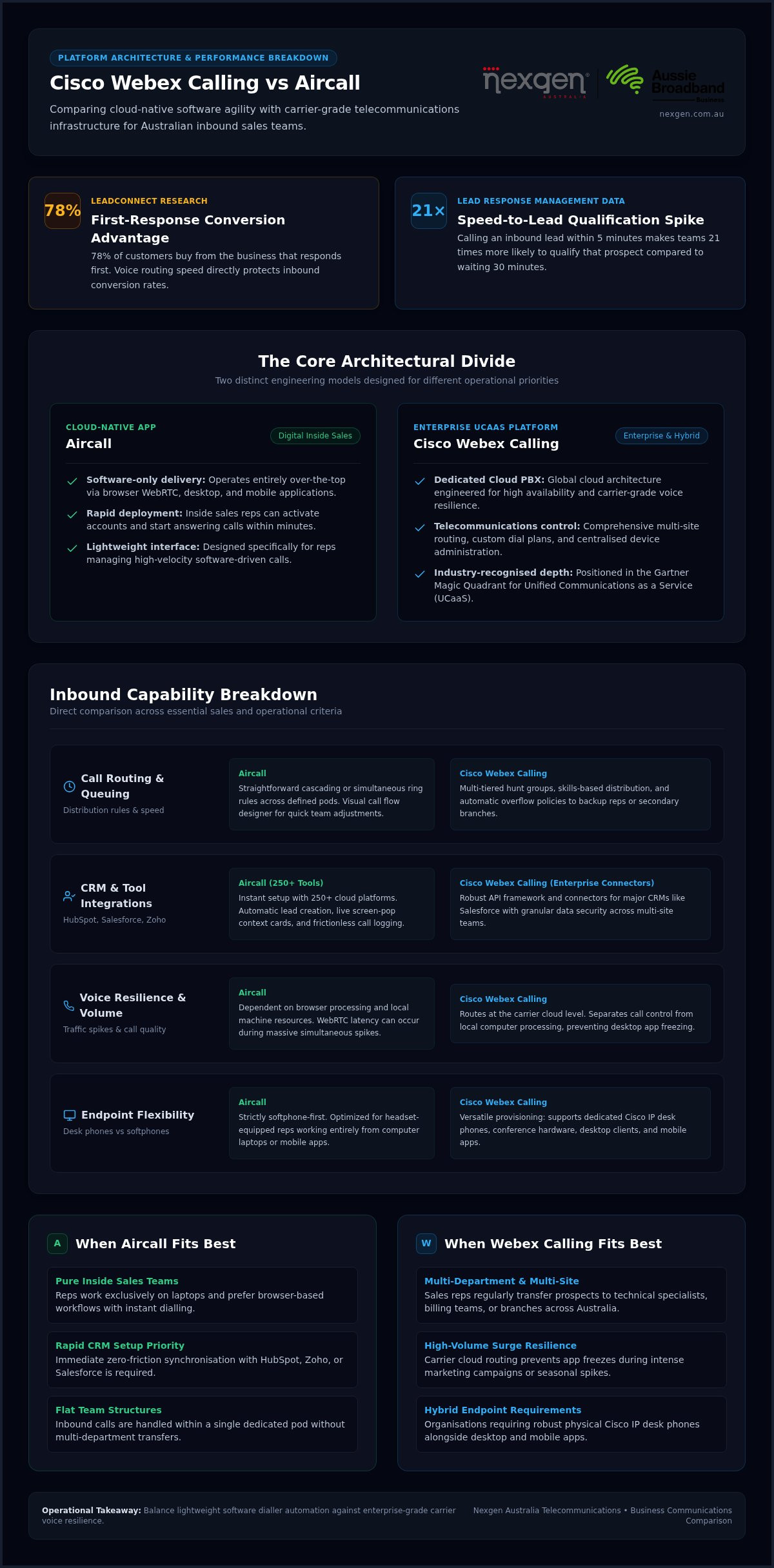
LeadConnect research shows that 78% of customers buy from the business that responds first. When a qualified prospect picks up the phone to talk to your business, every second lost to sluggish routing or jittery voice quality eats directly into your conversion rates. Choosing between Cisco Webex Calling vs Aircall for inbound sales teams usually comes down to a crucial operational choice: do you back the agile, app-centric software workflows of a digital-first dialler, or the rock-solid voice stability and handset flexibility of enterprise cloud communications?
You already know that clunky call logging and dropped connections frustrate your sales reps and push high-intent buyers straight to your competitors. In this guide, we evaluate both platforms across call routing speed, CRM integrations, local Australian voice reliability, and practical operational fit. Here is a clear, side-by-side comparison to help you select the platform that protects your speed-to-lead and keeps your inbound pipeline converting.
Key Takeaways
- Evaluating Cisco Webex Calling vs Aircall for inbound sales teams comes down to balancing agile, browser-based CRM workflows against carrier-grade voice infrastructure.
- Aircall offers rapid out-of-the-box integrations with CRMs like HubSpot and Salesforce, making it ideal for digital-first inside sales teams wanting instant contact history.
- Webex Calling delivers stronger voice resilience across Australia, backing sales operations with enterprise-grade call routing and local carrier infrastructure rather than relying solely on browser WebRTC.
- Hybrid sales environments that require physical IP desk phones alongside desktop and mobile apps will find Cisco hardware provisioning far more versatile than Aircall’s softphone-only model.
- Your choice ultimately hinges on whether your pipeline depends on lightweight dialler automation or mission-critical voice stability across distributed teams.
Cisco Webex Calling vs Aircall: High-Level Platform Breakdown
Evaluating Cisco Webex Calling vs Aircall for inbound sales teams begins with a clear architectural divide. Both solutions deliver modern Voice over IP (VoIP) calling, but they approach inbound sales from entirely different engineering philosophies. Aircall functions as a nimble, browser-centric software tool built deliberately for digital sales reps. Cisco Webex Calling, by contrast, provides an enterprise-grade unified communications ecosystem that pairs advanced cloud PBX capabilities with extensive carrier-grade stability.
The Core Architecture: Cloud-Native App vs Enterprise UCaaS
Aircall uses an over-the-top, software-only model. It routes calls through desktop applications, browser WebRTC, and mobile apps without requiring any dedicated telecommunications hardware. This structure enables rapid deployment, letting inside sales reps start answering calls within minutes of account creation.
Cisco Webex Calling operates on a dedicated global cloud architecture designed for high availability and deep telecommunications control. When deployed alongside high-performance local network infrastructure, Webex separates call control from local computer processing. For Australian operations managers, this means administrative control extends beyond basic software toggles to complete multi-site call routing, custom dial plans, and centralised device management across distributed teams.
Target Use Cases for Australian Inbound Sales
When weighing Cisco Webex Calling vs Aircall for inbound sales teams, operational structure dictates the right fit:
- Aircall suits pure inside sales teams: If your team works entirely on laptops, relies heavily on browser-based workflows, and needs quick out-of-the-box software activation, Aircall delivers an accessible, user-friendly interface.
- Webex Calling suits multi-department and hybrid organisations: If your inbound sales reps need to transfer prospects directly to technical specialists, billing teams, or branch offices across Australia, Webex connects the entire business under one secure unified platform.
- Inbound volume resilience: During high-traffic marketing campaigns or seasonal sales surges, Webex routes traffic at the carrier cloud level. This prevents the desktop app freezes or WebRTC latency issues that can occur when software diallers handle sudden call spikes.
Your decision centres on whether your sales pipeline prioritises a lightweight dialler application or a resilient telecommunications backbone that scales across your entire enterprise.
Inbound Call Routing, Speed-to-Lead, and CRM Integration
Speed-to-lead determines inbound sales outcomes. According to Lead Response Management data, contacting an inbound inquiry within 5 minutes makes a team 21 times more likely to qualify that prospect compared to waiting 30 minutes. In the comparison between Cisco Webex Calling vs Aircall for inbound sales teams, routing speed and CRM data synchronisation represent the front line of pipeline conversion.
Routing Mechanics: Hunt Groups, Queues, and Priority Handling
Aircall uses straightforward cascading or simultaneous ring rules across defined sales teams. Its visual call flow designer lets managers adjust ring durations quickly, which works nicely for flat sales pods. Webex Calling approaches routing with carrier-grade depth, recognised across the industry in benchmarks like the Gartner Magic Quadrant for UCaaS. It provides multi-tiered hunt groups, skills-based distribution, and automatic overflow policies. When caller queues build up, Webex redirects high-value inquiries to available backup reps or secondary branches before prospects hang up.
Connecting Telephony to Salesforce, HubSpot, and Leading CRMs
CRM integration mechanics highlight a key operational divide between the two systems:
- Aircall native integrations: Aircall connects instantly with over 250 cloud tools, including HubSpot, Salesforce, and Zoho. It triggers automatic contact creation, displays live caller context cards on the rep’s screen, and logs call recordings directly against the lead record without complex setup.
- Webex Calling enterprise workflows: Webex supports major CRMs like Salesforce through purpose-built connectors and robust APIs. While initial setup requires deliberate configuration, it logs call metrics with granular security controls, ensuring multi-site sales teams maintain immaculate records across central databases.
If your team requires custom call flows mapped directly into your existing software stack, partnering with an experienced provider like Nexgen for managed cloud communications ensures your routing architecture captures every opportunity without administrative headaches.
Sales Coaching: Live Listening, Whispering, and Call Recording
Both platforms offer call recording, silent monitoring, and whisper coaching to help sales managers upskill reps during live calls. Aircall handles live coaching directly from its desktop interface, letting supervisors jump into ongoing conversations or review past recordings linked inside CRM timelines. Webex Calling pairs live supervisor barging and queue monitoring with enterprise compliance storage and automated transcriptions, giving sales directors clear oversight across national inbound campaigns.
Audio Quality, Voice Resilience, and Australian Carrier Infrastructure
Voice clarity directly drives conversion rates during an inbound pitch. When a buyer experiences robotic audio, unnatural delays, or sudden dropouts, trust evaporates before your rep finishes their qualification questions. When evaluating Cisco Webex Calling vs Aircall for inbound sales teams, audio resilience often becomes the defining operational differentiator between lightweight software and carrier-grade telecommunications.
WebRTC and App Audio vs Carrier-Grade Cloud Telephony
Aircall relies on over-the-top WebRTC transmission via desktop applications and local browser sessions. While convenient for rapid deployment, this makes call clarity entirely dependent on local computer processing and unmanaged internet links. If a rep runs multiple CRM tabs, video downloads, or heavy browser extensions on an unmanaged home Wi-Fi connection, packet loss and voice jitter quickly creep in.
Webex Calling isolates and protects audio streams using advanced Opus codecs and dedicated packet loss concealment algorithms. Crucially, Webex voice traffic can be prioritised with Quality of Service (QoS) rules across commercial business connections. When paired with high-performance local data links, voice packets bypass congested public internet routing. This delivers clear, predictable sound quality across every sales call, regardless of how hard your sales floor pushes local network bandwidth.
Uptime SLAs and Business Continuity for Mission-Critical Sales
Inbound sales teams cannot afford unexpected phone downtime during peak campaign hours. Evaluating platform reliability reveals two distinct operating standards:
- Aircall cloud software availability: Aircall provides an operational status dashboard, but its underlying dependency on third-party public cloud hosting and local internet stability leaves teams vulnerable to unannounced browser or network disconnects.
- Cisco carrier-grade infrastructure: Cisco backs Webex Calling with an enterprise 99.999% cloud availability standard, supported by geo-redundant data centres and dedicated carrier peering.
For Australian businesses, local carrier backing makes all the difference. When you deploy Webex Calling backed by Australian infrastructure providers like Aussie Broadband, your voice calls run over low-latency domestic transit paths rather than bouncing across offshore routing points. Integrating this resilient cloud architecture with proven small business phone systems Australia ensures automated failover routing to mobile devices or secondary sites if a local branch internet link ever cuts out.
Hardware Support, Hybrid Mobility, and Endpoint Flexibility
Modern inbound sales environments rarely operate in a single physical mode. Some team members thrive on lightweight laptop setups, while others achieve higher conversion rates using dedicated physical handsets. A critical distinction in the battle of Cisco Webex Calling vs Aircall for inbound sales teams lies in physical endpoint support. Aircall is built solely as a software dialler, whereas Cisco supports a comprehensive ecosystem of hardware alongside its digital apps.
Desk Phone Fleets vs Headset-Only Softphones
Aircall intentionally operates without native desk phone provisioning. Every agent must handle incoming calls using a computer headset and desktop application. While this reduces initial equipment footprint, it can introduce friction on busy sales floors:
- Agent ergonomics: Sales reps taking calls for six to eight hours a day frequently experience audio fatigue from continuous computer headset use.
- Hardware reliability: Cisco Multiplatform (MPP) IP desk phones run on dedicated processors with built-in acoustic shielding. They isolate voice processing completely from computer crashes, operating system updates, or USB headset driver conflicts.
- Tactile controls: Physical transfer keys, dedicated mute buttons, and visual line indicators allow reps to manage multiple inbound lines with confidence during complex negotiations.
Empowering Hybrid and Mobile Sales Agents Across Australia
Both platforms cater to remote staff, but their mobility models diverge when reps move away from their desks. Aircall provides responsive iOS and Android apps that mirror its desktop dialler, alerting reps via mobile push notifications. However, call handoffs remain app-bound, requiring steady mobile data to avoid unexpected drops.
Cisco Webex Calling bridges physical and mobile workflows effortlessly. An inbound call can ring a rep’s Cisco MPP desk phone, desktop application, and mobile device simultaneously. Through features like Webex Go, mobile devices integrate directly at the cellular level with a single business identity. This lets agents transfer a live sales call from their mobile handset straight to their office desk phone mid-conversation without interrupting the customer.
If your organisation wants to equip hybrid reps with high-grade IP handsets alongside cloud mobility, you can explore Cisco Webex Calling phone systems with Nexgen to design a flexible deployment tailored to your operational floor plan.
Making the Right Choice: Which Sales System Fits Your Business?
Deciding between Cisco Webex Calling vs Aircall for inbound sales teams ultimately comes down to your operating model and technological maturity. Aircall serves teams seeking a rapid, software-only overlay for their inside sales reps. Cisco Webex Calling delivers an enterprise-grade communications foundation designed for organisations that view phone reliability as mission-critical infrastructure.
When Aircall Is the Right Operational Fit
Aircall delivers clear commercial value for specific sales environments. It represents a practical choice if your business matches the following operational profile:
- Digital-first sales pods: Your inside reps work entirely within cloud platforms like HubSpot or Pipedrive, needing an agile click-to-dial widget with minimal technical onboarding.
- Self-service software management: You have an in-house operations manager comfortable creating users, configuring basic ring groups, and maintaining software settings without dedicated telecommunications assistance.
- Headset-only remote workforces: Your sales staff operate exclusively from laptops in home offices and do not require physical desk phones or multi-site hardware provisioning.
When Cisco Webex Calling Is the Superior Investment
Webex Calling stands out when your inbound sales function requires structural reliability, multi-department reach, and dedicated telecommunications backing. It is the stronger commercial investment for:
- High-volume inbound sales floors: When missed calls and audio dropouts directly impact quarterly pipeline, Webex provides carrier-grade voice architecture and 99.999% availability.
- Hybrid office environments: Businesses needing physical Cisco IP handsets on office desks alongside robust mobile apps gain unmatched hardware longevity and acoustic performance.
- Unified enterprise communications: Rather than paying for isolated point solutions, Webex combines phone lines, video conferencing, and team messaging into a single administrative platform.
- Full deployment and local management: Organisations that prefer an expert telecommunications partner to handle call flow design, number porting, and ongoing support benefit from working with an authorised provider like Nexgen, backed by Aussie Broadband network infrastructure.
By weighing your team’s workflow habits against your technical requirements, you can select the platform that eliminates sales friction and supports long-term revenue growth across Australia.
Maximise Your Inbound Sales Conversion Rates
Every inbound call represents hard-won marketing investment and immediate revenue potential. Choosing between Cisco Webex Calling vs Aircall for inbound sales teams ultimately hinges on what protects your speed-to-lead and caller trust. While Aircall offers quick software-only setup for lightweight browser dialling, Webex Calling delivers the enterprise uptime, acoustic clarity, and multi-endpoint flexibility required for long-term commercial growth.
Getting your voice infrastructure right doesn’t have to become an operational headache. Nexgen delivers authorised Cisco Webex Calling deployments backed by robust Aussie Broadband network infrastructure. We manage your entire transition locally, from tailored call flow architecture and smooth carrier number porting to complete hardware provisioning, backed by dedicated Australian business support.
Ready to modernise your sales communications with an engineered voice platform? Talk to Nexgen about the right business phone system for your sales team and give your reps the dependable tools they need to convert every qualified lead with confidence.
Frequently Asked Questions
Can sales reps use physical desk phones with Aircall?
No, Aircall does not provide native hardware provisioning or support for physical IP desk phones. It operates strictly as a computer softphone and mobile application. Sales reps must use USB or Bluetooth headsets connected to laptops or smartphones. If your sales team requires dedicated IP handsets with physical line keys, dedicated mute controls, and hardware acoustic shielding, Cisco Webex Calling is the appropriate platform.
Does Cisco Webex Calling integrate natively with CRMs like Salesforce and HubSpot?
Yes, Cisco Webex Calling integrates with major customer relationship management platforms including Salesforce and HubSpot through dedicated connectors and Webex App Hub integrations. While Aircall provides quick click-and-connect widgets for fast software setups, Webex connects deeply with enterprise CRM environments. It enables automated call logging, contact record matching, and inbound caller screen pops while maintaining strict enterprise security controls across your entire organisation.
Which platform provides better voice quality for Australian remote sales teams?
Cisco Webex Calling consistently delivers superior audio resilience for distributed teams across Australia. While Aircall relies entirely on public internet WebRTC routing that can suffer from jitter and packet loss on congested home connections, Webex utilises advanced Opus codecs. When deployed through Nexgen and backed by Aussie Broadband network infrastructure, calls benefit from prioritised local routing paths that preserve crisp audio clarity across remote locations.
What is the main difference between Webex Calling and Aircall for inbound sales?
The main difference between Cisco Webex Calling vs Aircall for inbound sales teams is the trade-off between lightweight software diallers and carrier-grade telecommunications infrastructure. Aircall focuses on browser-first workflows and rapid app integrations for inside sales pods. Webex Calling delivers full-scale cloud PBX architecture, advanced multi-level hunt groups, physical handset support, and unified meetings and messaging built for scalable, multi-department business operations.
Can our business keep our existing Australian phone numbers when switching?
Yes, your business can retain all existing Australian 1300, 1800, and local geographic phone numbers when moving to either platform. Australian telecommunications regulations guarantee local number porting between licensed carriers. When deploying Cisco Webex Calling through Nexgen, our Australian team coordinates the entire porting schedule directly with your current provider. This ensures zero operational downtime or lost inbound leads during the transition.
Is Cisco Webex Calling difficult to set up and manage compared to Aircall?
While Aircall offers simpler self-service setup for basic software users, Cisco Webex Calling becomes straightforward when managed by an authorised deployment partner. Evaluating Cisco Webex Calling vs Aircall for inbound sales teams often raises concerns about configuration complexity. However, Nexgen handles your complete hardware provisioning, user onboarding, and call flow architecture from start to finish, giving you enterprise-grade performance without the internal technical burden.