

> Overview
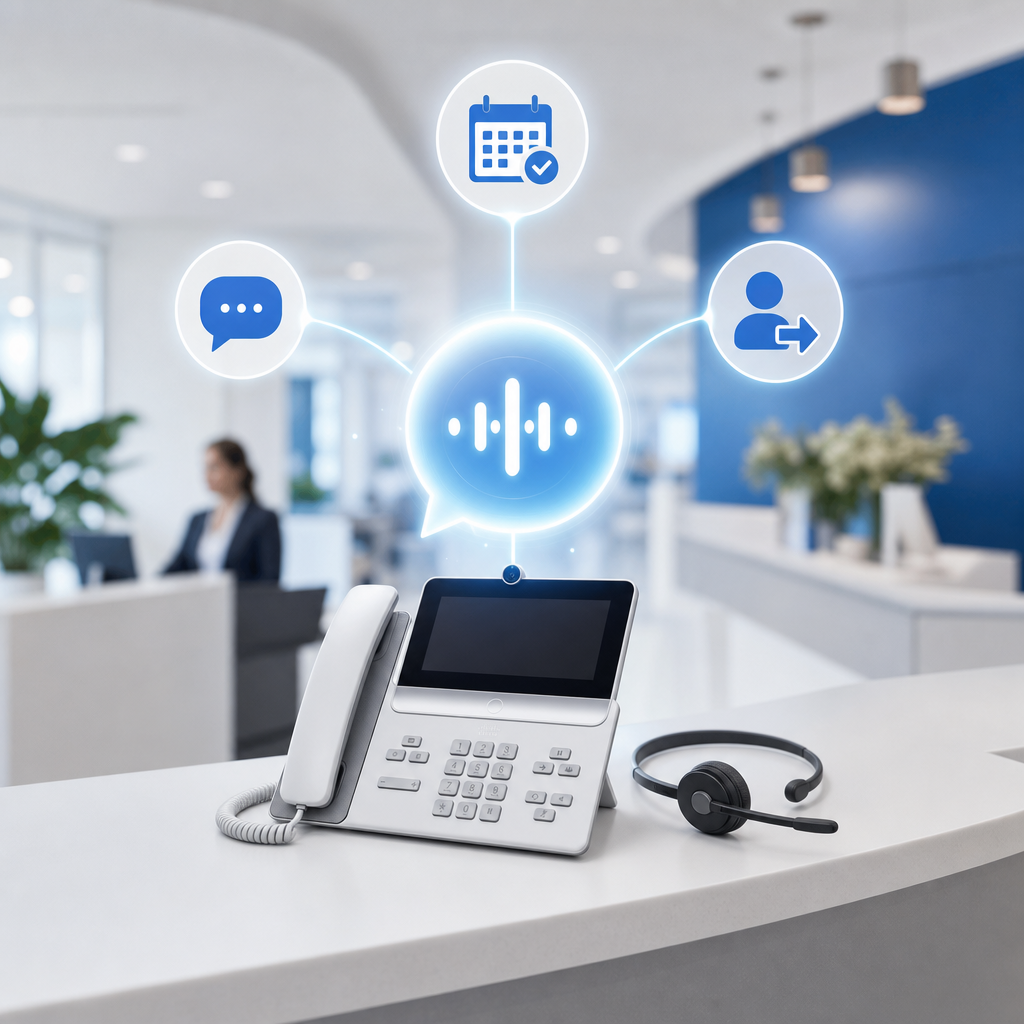
> An AI receptionist for business answers inbound calls automatically, greeting callers, answering common questions, and routing or booking as needed. It typically replaces after-hours answering, basic call screening, and repetitive front-desk tasks, without eliminating the option for a real person to step in.
Table of contents
- What is an AI receptionist for business?
- How does an AI receptionist benefit your business?
- What does an AI receptionist actually replace?
- Is an AI receptionist better than a human receptionist?
- Setting up an AI receptionist — what’s involved
- What to look for in an AI receptionist provider
- FAQ
Every missed call is either a lost customer or a lost opportunity to look professional, but staffing a phone line every hour a business might get a call isn’t realistic for most small teams. Someone’s on the tools, in a meeting, or it’s 6pm and the office is closed. That’s usually where calls start going to voicemail, and voicemail is usually where customers hang up and call the next business on the list instead.
An AI receptionist for business is designed to close exactly that gap. Rather than a call going unanswered, it answers immediately, handles the routine part of the conversation, and only escalates to a real person when the call actually needs one. For Australian SMBs already running on a cloud PBX, it’s often a straightforward addition rather than a separate system to manage.
This guide explains what an AI receptionist actually does, what tasks it genuinely replaces (and what it doesn’t), and what to check before adding one to your existing phone setup.
—
Business phone plans
Stop missing calls your business can’t afford to lose
See how an AI receptionist would handle your call volume, day and after hours.
—
What is an AI receptionist for business?
An AI receptionist is a software-based answering service that picks up inbound business calls and handles the conversation using voice AI, rather than a recorded voicemail message or a human on the other end. It can greet the caller, answer common questions about your business (hours, location, services offered), take a message, book an appointment, or transfer the call to the right person or team.
Unlike a basic auto-attendant that just offers a menu of options (“press 1 for sales”), an AI receptionist can actually hold a natural conversation, understand what the caller needs, and respond accordingly. It typically integrates with your existing cloud PBX or business phone system, so it works alongside your current number and call flow rather than requiring a completely separate setup.
How does an AI receptionist benefit your business?
No more missed calls. Every call gets answered immediately, whether it comes in during business hours, on a lunch break, or after the office has closed for the day.
Consistent first impression. Every caller gets the same professional greeting and accurate information, rather than quality varying depending on who happens to pick up, or whether anyone does at all.
Frees up staff time. Routine questions, hours, pricing basics, appointment requests, get handled without pulling a staff member away from other work to answer the phone.
Better call routing. Calls that do need a person are directed to the right team or individual straight away, instead of being passed around or put on hold while someone figures out who should take it.
Captures leads outside business hours. A call at 7pm from a potential customer doesn’t have to go to voicemail and risk being forgotten, it can be answered, logged, and followed up on the next business day.
What does an AI receptionist actually replace?
It’s worth being specific about what an AI receptionist genuinely replaces, rather than assuming it’s a wholesale substitute for a person.
Replaces:
- After-hours voicemail and missed-call follow-up
- Basic call screening and routing
- Answering repetitive FAQs (hours, location, services)
- Simple appointment booking or message-taking
- Overflow handling when staff are busy or unavailable
Doesn’t replace:
- Complex customer service conversations requiring judgement
- Sales conversations that need a human relationship
- Sensitive or emotionally charged calls
- Situations where a caller specifically wants to speak to a person and isn’t satisfied with anything else
The realistic framing is that an AI receptionist takes the repetitive, high-volume, low-complexity part of call handling off your team’s plate, while still escalating to a real person for anything that genuinely needs one.
Is an AI receptionist better than a human receptionist?
| AI receptionist | Human receptionist | |
|---|---|---|
| Availability | 24/7, including after hours and weekends | Limited to rostered working hours |
| Consistency | Same greeting and information every time | Can vary by staff member, mood, or workload |
| Cost structure | Typically a flat software cost, scales with call volume | Wages, leave, training, and management overhead |
| Complex conversations | Limited, escalates to a person when needed | Handles nuance, empathy, and judgement calls naturally |
| Best suited to | High call volume, repetitive questions, after-hours coverage | Relationship-driven calls, complex or sensitive conversations |
| Setup effort | Configuration and integration with your phone system | Hiring, onboarding, and ongoing management |
For most small businesses, the realistic answer isn’t choosing one over the other, it’s using an AI receptionist to cover the volume and hours a human receptionist can’t, while keeping a person available for the calls that genuinely need one.
Read more: Microsoft Teams Phone System: Your Business Line →
Setting up an AI receptionist — what’s involved
- Assessment – a provider reviews your call volume, common enquiry types, and existing phone system to scope what the AI receptionist needs to handle.
- Script and knowledge setup – your business hours, services, and common FAQ answers are configured so the AI receptionist responds accurately.
- Integration with your phone system – the AI receptionist connects to your existing business number and call flow, so calls route to it seamlessly.
- Escalation rules configuration – rules are set for when a call should be handed to a real person rather than handled entirely by the AI.
- Testing before go-live – calls are tested to confirm greetings, routing, and escalation work as expected before the system takes live calls.
- Ongoing refinement – responses and routing rules are adjusted over time as you learn what callers actually ask.
What to look for in an AI receptionist provider
1. Genuine integration with your existing phone system. Confirm the AI receptionist works with your current cloud PBX setup, not as a bolt-on requiring a separate number.
2. Clear escalation logic. Ask exactly how and when calls get handed to a real person, and how easily those rules can be adjusted as you learn what works.
3. Transparent pricing. Understand whether pricing is per call, per minute, or a flat monthly fee, and what happens if your call volume grows.
4. Accuracy of information handling. Check how the system is kept up to date with your business hours, pricing, and service details, so callers aren’t given outdated information.
5. Local, contactable support. If the AI misroutes a call or a setting needs adjusting, Australian-based support that understands your setup matters more than a generic help centre.
FAQ
What is an AI receptionist for a business phone system?
It’s software that answers inbound calls automatically, using voice AI to greet callers, answer common questions, and route or book calls as needed, integrated with your existing business phone system.
Does an AI receptionist replace a human receptionist completely?
Not entirely. It handles repetitive, high-volume tasks like after-hours answering and basic enquiries well, but complex or sensitive conversations generally still benefit from being escalated to a real person.
Can an AI receptionist work with my existing phone system?
Usually yes. Most AI receptionist solutions integrate with your existing cloud PBX or business phone system rather than requiring a completely separate setup or number.
Will callers know they’re speaking to an AI?
This depends on the provider and configuration. Many businesses are upfront about it, while the conversation itself is designed to feel natural and helpful regardless.
How much does an AI receptionist cost for a small business?
Pricing varies by provider and call volume, often structured per call, per minute, or as a flat monthly fee. It’s best confirmed with a tailored quote based on your business’s actual call patterns.
What happens if the AI receptionist can’t answer a caller’s question?
A properly configured system escalates the call to a real person or takes a detailed message for follow-up, rather than leaving the caller without a resolution.
Never miss another call
An AI receptionist won’t replace the value of a real conversation when a customer needs one, but it does mean your business stops losing calls to voicemail, after-hours gaps, or a busy front desk.
Nexgen has helped Australian businesses modernise their phone systems for 17 years, with local support and a setup process built around how your business actually operates. Get in touch with our team or call 1300 020 402 to see whether an AI receptionist is the right fit for your business.