

VoIP Solutions for Small Business Australia: The 2026 Guide

Most call dropouts, jitter, and distorted audio on office phones have very little to do with cloud technology itself. If you’ve hesitated to explore voip solutions for small business australia because you worry a standard NBN connection will drop calls or garble client conversations, you aren’t alone. Clunky legacy PABX hardware is frustrating and expensive to maintain, yet the fear of messy network provisioning, downtime, and hidden licensing fees keeps many business owners stuck with outdated systems.

You don’t have to trade rock-solid voice reliability for modern workplace flexibility. In this guide, you’ll discover how modern cloud VoIP solutions empower Australian small businesses with scalable, dependable, and cost-effective voice communications across desk handsets, laptops, and mobile phones. We examine how to configure your broadband to protect voice quality, how your team can manage calls from any device, and how to transition your numbers smoothly into one predictable operating expense.

Key Takeaways

  • Explore how purpose-built voip solutions for small business australia replace rigid copper legacy systems with scalable, flexible cloud architecture.
  • Discover the vital call management features that improve client responsiveness, including automated attendants, presence indicators, and mobile softphones.
  • Understand the total operational cost differences between maintaining legacy on-premise PBX boxes and shifting to cloud-hosted infrastructure.
  • Learn the fundamental network performance benchmarks, from router Quality of Service (QoS) to bandwidth sizing, required for crystal-clear voice on your NBN connection.
  • Compare the practical risks of self-configured DIY phone setups against fully managed deployments that protect existing numbers and eliminate downtime.

Demystifying Modern VoIP Solutions for Australian Small Business

Voice over Internet Protocol is not just a consumer calling app or a simple adaptor plugged into a home modem. Commercial-grade VoIP transforms voice into high-definition digital data packets, transmitting conversations securely across existing broadband networks. With legacy ISDN networks and traditional copper lines retired across the national fixed-line footprint, adopting digital voice has become an operational necessity rather than an optional tech upgrade. For growing enterprises, modern voip solutions for small business australia deliver enterprise-grade call routing, multi-device accessibility, and centralised management without the heavy capital expense of legacy hardware.

The Mechanics of Cloud-Delivered Business Voice

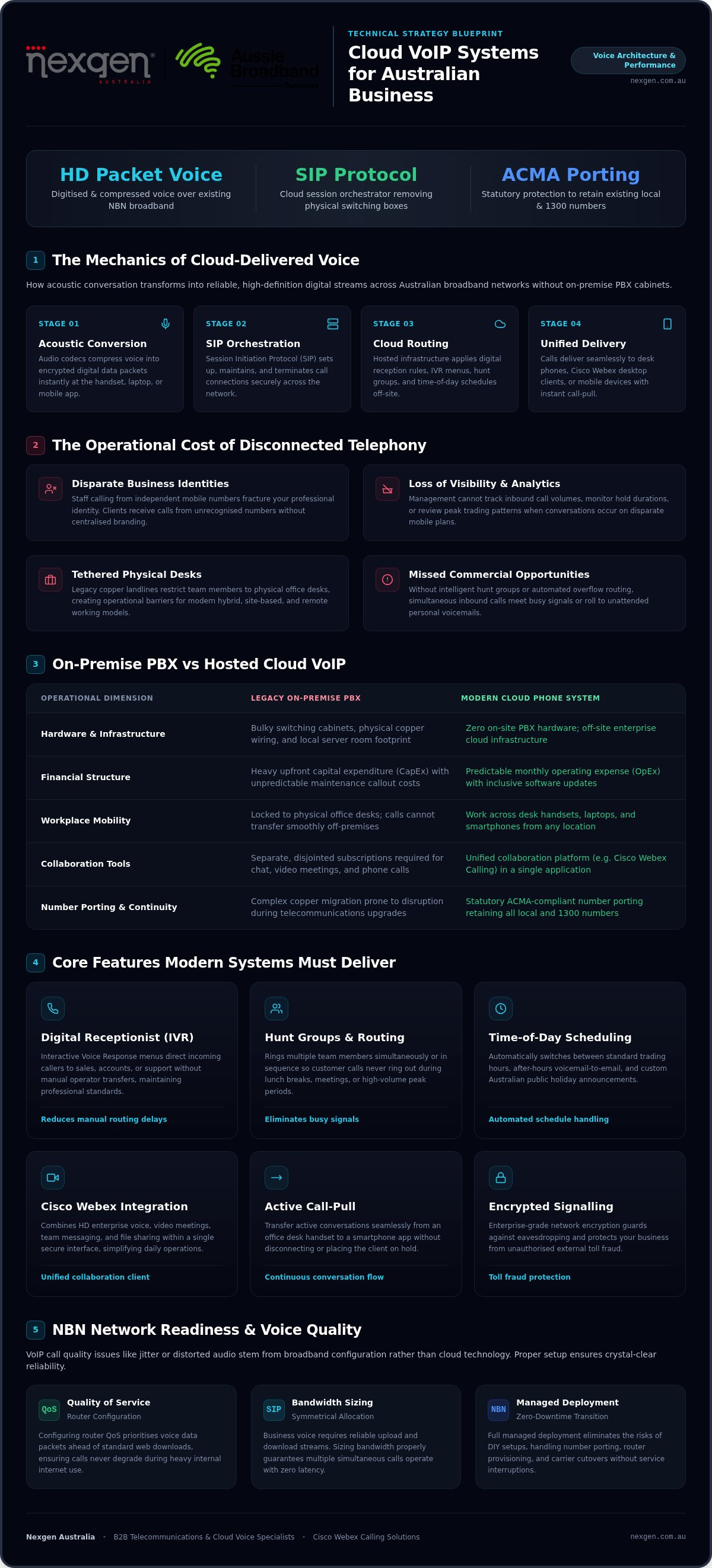
When someone speaks into an IP handset or computer headset, the system converts acoustic sound into compressed digital packets using audio codecs. These packets travel across packet-switched IP networks using established Voice over IP technology standards, governed by Session Initiation Protocol (SIP). SIP acts as the digital orchestrator; it establishes the call, maintains audio integrity, and terminates the connection securely. Cloud-hosted infrastructure handles this call management off-site, removing the need for physical switching cabinets, dedicated copper pairs, and complex local telephone wiring.

Why Traditional Copper Lines and Mobile Workarounds Fail

Many business owners attempt to bridge telecommunications gaps by arming team members with independent mobile phones. While mobile coverage is convenient, this practice quickly fractures customer service and weakens operational control.

  • Disparate identities: Customers receive calls from different, unrecognised mobile numbers rather than a single, unified business line.
  • Loss of visibility: Operations managers cannot track call volumes, monitor hold durations, or review peak trading patterns.
  • Tethered desktop phones: Legacy landlines lock team members to specific physical desks, which severely restricts hybrid or remote working arrangements.
  • Missed commercial opportunities: Without intelligent hunt groups or automated overflow routing, simultaneous inbound calls receive a busy signal or roll to individual mobile voicemails, costing your business valuable leads.

Commercial VoIP bypasses these pitfalls entirely. By unifying your communications under an adaptable cloud platform provided by Nexgen Australia, your organisation presents a cohesive, professional identity to every caller while giving your team total freedom to work productively from any location.

Essential Features Modern Business VoIP Systems Must Deliver

Evaluating voip solutions for small business australia requires looking beyond basic dial tones. A robust platform operates as an intelligent communication hub, lifting customer response rates while protecting your business against toll fraud through encrypted signalling. Switching providers shouldn’t disrupt your brand continuity either. Under statutory ACMA guidelines on porting your phone number, your business retains full ownership of its existing local geographic or 1300 numbers, which an experienced voice provider can port smoothly behind the scenes.

Intelligent Call Routing and Digital Receptionists

Interactive Voice Response (IVR) menus act as a digital front desk, directing callers to sales, accounts, or service without manual transfers. Hunt groups route inbound calls across available team members simultaneously or sequentially, ensuring customer calls never ring out during lunch breaks or rush periods. With time-of-day routing, your system switches automatically between standard trading hours, after-hours messaging, and customised public holiday announcements without manual reconfiguration.

Enterprise Collaboration via Cisco Webex Calling

Australian small businesses often wrestle with separate, disjointed software subscriptions for team chat, video meetings, and phone calls. Cisco Webex Calling solves this friction by unifying HD voice, secure messaging, and video conferencing within a single client. Smaller commercial operations gain the same call-handling depth as large enterprises without managing complex on-site infrastructure. Active call-pull capabilities let staff start a conversation on an office desk handset and shift it to a smartphone instantly when stepping out the door.

Mobile Softphones and Multi-Device Connectivity

Softphone applications turn laptops, tablets, and mobile handsets into fully functional office extensions. Staff can call clients from anywhere while presenting your primary company number, preserving personal mobile privacy. Unified messaging delivers voicemail audio and transcriptions directly to staff email inboxes, while real-time presence indicators show whether colleagues are on a call, in a meeting, or available. Centralised management portals also allow office managers to reassign extensions, add users, or update permissions in minutes. To match these capabilities to your operational setup, explore the options available through Nexgen Australia’s cloud phone systems.

Comparing On-Premise PBX and Cloud Phone Systems

Deciding between physical telephone hardware and a virtual cloud exchange comes down to operational control, capital allocation, and long-term agility. For decades, Australian enterprises purchased private automatic branch exchange (PBX) boxes mounted directly inside on-site server racks. Today, modern voip solutions for small business australia shift that entire voice architecture to high-availability Australian data centres, replacing fragile hardware cabinets with software-driven management.

Capital Expenditure Versus Predictable Operating Expenses

Traditional PBX systems demand significant capital expenditure upfront. Your business pays for proprietary server equipment, expansion cards, physical handsets, and initial technician installation before making a single phone call. Beyond that purchase price, legacy hardware requires costly annual vendor maintenance contracts and paid service callouts whenever you want to reconfigure an extension or update call flows.

Cloud-hosted telephony eliminates that hardware burden by turning business communications into a predictable operating expense. Rather than budgeting for system obsolescence every five to seven years, your organisation pays for active user licences. Security patches, platform improvements, and feature updates deploy automatically in the cloud, removing unexpected repair invoices and giving your organisation immediate access to the latest voice technology.

Scalability, System Redundancy, and Disaster Recovery

Physical PBX equipment creates a single point of operational failure. If your office loses mains power, suffers hardware failure, or experiences a local carrier cable fault, your entire phone system shuts down instantly. Inbound callers meet dead silence, which can stall customer service and damage commercial goodwill during critical trading hours.

Cloud systems remove that vulnerability through geographic redundancy. Because the PBX engine resides off-site in resilient data facilities, your telephone network remains completely operational even during a local power blackout. Calls redirect automatically to remote laptops, softphone applications, or backup mobile numbers without caller interruption. Evaluating regular ACCC broadband performance data helps confirm your local data connection can support this failover model reliably.

Scaling a cloud-based setup is equally straightforward. When onboarding new staff, operations managers can provision new extensions and assign business numbers through a web console in minutes. Multi-site businesses can link distributed locations, remote workers, and head office teams under one centralised dial plan without purchasing separate physical switches for each address.
Voip solutions for small business australia

Assessing Network Readiness and NBN Performance for VoIP

Poor voice clarity is rarely caused by the cloud platform hosting your calls. In commercial offices, robotic speech, delayed audio, and dropped connections almost always trace back to local network bottlenecks or unoptimised internet links. Understanding network tolerances ensures that deploying voip solutions for small business australia results in immediate operational improvements rather than team frustration.

Real-time voice requires strict performance standards across your broadband connection:

  • One-way latency: Must stay below 150 milliseconds (ms). Any latency over 200 ms creates frustrating talk-over pauses where callers constantly interrupt each other.
  • Network jitter: Must remain under 30 ms. High jitter produces jagged, broken syllables as packets arrive out of sequential order.
  • Packet loss: Must not exceed 1%. When packet loss reaches 2% to 3%, noticeable audio gaps occur, dropping entire words out of client conversations.

Calculating Concurrent Call Capacity and Bandwidth Needs

Bandwidth calculations must account for uncompressed high-definition audio codecs like G.711 or G.722, which require roughly 85 kbps to 100 kbps of symmetrical bandwidth per active line. Telecommunications engineers recommend budgeting 100 kbps to 150 kbps per concurrent call, including a 20% headroom buffer. In small-to-medium enterprises with 10 to 50 staff, peak phone traffic typically engages between 40% and 60% of total staff simultaneously. A business running 20 concurrent calls requires at least 3 Mbps of clean, dedicated symmetrical upload and download throughput set aside exclusively for voice.

Configuring Quality of Service on Office Network Equipment

Standard business broadband operates on NBN Traffic Class 4 (TC-4), a best-effort, asymmetrical data service. When someone in the office uploads a massive graphic presentation, sends off a batch of marketing videos, or runs an unthrottled cloud backup, that data saturates the upload pipe. Without Quality of Service (QoS) rules active on your router, time-sensitive voice packets get stuck behind bulk file transfers.

Enabling QoS gives voice packets absolute priority over general office traffic. High-priority voice data skips ahead in the router queue, preserving call stability during peak usage. On-premise hardware should also feature Cat6 cabling, dedicated Voice VLAN segmentation, and managed Power over Ethernet (PoE) switches to feed IP desk phones clean power and direct local connectivity.

Managing Seamless Number Portability Without Disruption

Migrating to cloud telephony requires careful coordination under Australian Local Number Portability (LNP) rules. To prevent accidental business disruption, never cancel existing copper or voice contracts with your current carrier before the technical porting window completes. Cancelling early forfeits ownership of your telephone numbers instantly, making recovery difficult and protracted. During the cutover window, your voice provider establishes temporary call diversions to ensure incoming client enquiries land uninterrupted while digital routing updates across the national carrier network. To evaluate your site’s readiness, audit your office infrastructure with Nexgen.

Selecting a Business VoIP Provider: Managed Service Versus DIY

Choosing between a self-service software download and a fully managed telecommunications partner shapes the daily operational reality of your business. While off-the-shelf digital platforms appear straightforward during online checkout, managing complex voice protocols without an internal network engineer turns self-serve software into an expensive drain on staff productivity. Selecting dependable voip solutions for small business australia requires balancing application features against the ongoing technical support needed to keep communications operating without friction.

The Hidden Frustrations of Self-Service VoIP Platforms

When call flows fail or endpoints unregister, DIY platforms leave your staff stranded in automated help centres or offshore ticketing queues. Configuring Session Initiation Protocol (SIP) credentials, firewall traversal, and Network Address Translation (NAT) rules requires dedicated expertise. When operations managers spend working hours troubleshooting dropped calls or broken ring groups, lost productivity quickly eclipses software savings. Misconfigured platforms also introduce serious operational risks, leaving system passwords exposed to automated toll fraud where malicious bots hijack unmonitored lines to dial premium international numbers.

The Value of an Australian Dedicated Telco Subsidiary

A managed telecommunications partner replaces generic self-help portals with direct local accountability. Operating since 2009 and backed as an official subsidiary of Aussie Broadband Limited (ASX: ABB), Nexgen Australia combines tier-one national network backing with responsive, consultative business support. Dedicated voice specialists assess your calling patterns, design custom routing architectures, and pre-configure Cisco business phones prior to delivery. Your staff simply connect the hardware to office Ethernet ports for true plug-and-play installation without touching complicated router code.

Taking the Next Step Toward Modernised Business Voice

Modernising your office phone system does not require operational guesswork or technical downtime. A structured communications assessment identifies your team’s exact workflow requirements, whether that involves hybrid softphones, multi-site hunt groups, or advanced collaboration tools. Because your existing telephone numbers remain completely protected and active throughout the deployment process, your organisation preserves commercial continuity from day one. Partnering with a proven voice provider ensures your team gains an adaptable, enterprise-grade phone system engineered to scale alongside your business.

Future-Proof Your Business Communications

Replacing legacy copper lines and rigid PBX hardware with purpose-built voip solutions for small business australia protects your operational continuity. By establishing local network Quality of Service and shifting call management to the cloud, your team gains the flexibility to answer calls professionally across desk handsets, laptops, and mobile apps without sacrificing voice clarity.

You don’t have to navigate SIP configurations or complex porting rules alone. Established in 2009 and backed as a dedicated B2B subsidiary of Aussie Broadband Limited (ASX: ABB), Nexgen Australia delivers complete, end-to-end managed voice deployments. As an authorised provider of Cisco Webex Calling phone systems, we take care of line provisioning, network checks, and number migrations so you can focus on running your business. Upgrade your business voice with a fully managed solution from Nexgen Australia and set your team up for sustainable growth.

Frequently Asked Questions

Can our business keep our existing phone numbers when switching to VoIP?

Yes, your business retains full legal rights to keep its existing phone numbers under Australian Local Number Portability rules. Whether you use geographic 02, 03, 07, or 08 landlines, or national 1300 and 1800 inbound services, your numbers can port directly to your new provider. A managed telco coordinates the cutover date with your current carrier, ensuring continuous phone operations without losing customer recognition or having to reprint marketing collateral.

What happens to our business phone system if our office internet goes down?

Inbound calls continue to operate because cloud-hosted phone systems process incoming traffic off-site in secure data facilities. If your local office loses internet connectivity, your automated call flows automatically divert inbound enquiries to predetermined backup destinations, such as staff mobile apps or secondary locations. Deploying a business-grade router configured with automated 4G or 5G mobile broadband failover also ensures on-site desk handsets restore internet voice within seconds.

Is VoIP voice quality as reliable and clear as traditional copper landlines?

Yes, modern business VoIP delivers voice quality that often exceeds traditional copper lines by using wideband high-definition audio codecs. As long as your local office data network maintains low packet loss and has Quality of Service prioritisation active on the router, calls sound crisp and natural. High-grade voip solutions for small business australia prevent jitter and delay, delivering the dependable, distortion-free sound your clients expect from a professional organisation.

How much internet bandwidth does a typical small business VoIP call require?

An uncompressed business VoIP call using standard G.711 or G.722 codecs requires roughly 100 kbps of symmetrical bandwidth in both upload and download directions. Telecommunications specialists recommend budgeting 100 kbps to 150 kbps per concurrent line, which builds in a 20% safety margin for network overheads. For an office handling ten simultaneous calls, reserving 1.5 Mbps of clean upload and download throughput ensures voice traffic never encounters network congestion.

Can our staff use desk handsets and mobile phone apps simultaneously?

Yes, modern platforms link physical desk phones, desktop software, and mobile apps to a single extension number. When an incoming call arrives, all designated devices ring at once, allowing employees to answer wherever they are situated. Team members can easily transition active calls between their office desk phone and their smartphone on the go, presenting a unified company identity without exposing personal mobile numbers to clients.

Do we need brand new data cabling installed in our office to support VoIP?

Most offices do not need rewiring if existing Cat5e or Cat6 data cabling is in good working order. Modern IP desk phones feature integrated dual-port Ethernet switches, which lets a handset and a desktop computer share a single wall jack without needing extra cabling runs. If your office layout relies partly on Wi-Fi, business-grade wireless access points can support voice endpoints, provided signal strength and local network bandwidth are properly managed.

What is the practical difference between a cloud phone system and an on-premise PBX?

The main operational difference lies in physical hardware ownership and day-to-day management. An on-premise PBX requires purchasing, mounting, and servicing expensive hardware switches inside your building, which leaves you vulnerable to on-site power faults. Cloud phone systems host all routing intelligence in remote, redundant Australian data centres. This architecture lets you scale user licences instantly, eliminate maintenance contracts, and manage call flows easily through an online portal.

How long does it typically take to transition an office phone system to VoIP?

Transition timeframes generally range from a few business days to several weeks, depending largely on carrier porting schedules. Setting up extensions, programming digital receptionists, and shipping pre-configured handsets takes only a few days. The formal transfer of complex number ranges under Australian carrier regulations takes roughly two to four weeks. Working with an experienced provider of voip solutions for small business australia ensures temporary diversions maintain total call continuity throughout that period.

Terms Of Use

Your access to the Nexgen website at https://www.nexgen.com.au is your acceptance of these Terms and Conditions and your access and use of the website is subject to these Terms and Conditions. If you do not accept these Terms and Conditions, you must refrain from using the Website. In these Terms and Conditions, capitalised words have special meanings. These special meanings are set out in the “General” section of this document.

Disclaimer of Liability – General Disclaimer

We are not liable to you or anyone else for any Loss in connection with use of this Website or a Linked Website or the failure to provide this Website.

This general disclaimer is not restricted or modified by any of the following specific warnings and disclaimers.

Disclaimer of Liability – Specific Warnings and Disclaimers

We are not liable to you or anyone else if interference with or damage to your computer systems occurs in connection with use of this Website or a Linked Website. You must take your own precautions to ensure that whatever you select for your use from this Website is free of viruses or anything else (such as worms or trojan horses) that may interfere with or damage the operations of your computer systems.

We may, from time to time, change or add to this Website (including these Terms and Conditions and privacy policy) or information, products or services without notice and your continued use of the Website will constitute acceptance of the variation. However, we do not undertake to keep this Website or these Terms and Conditions updated. We are not liable to you or anyone else if errors occur in the information on this Website or if that information is not up-to-date.

To the extent permitted by applicable law, all representations, warranties and other terms are excluded. You must ensure that your access to this Website is not illegal or prohibited by laws which apply to you or in your location.

To the extent permitted by applicable law, our liability for negligence, breach of contract or contravention of any law as a result of our failure to provide the Website, is limited to providing access to the Website.

You may not use the Website to collect or harvest Personal Information, including Internet addresses, about other users. You must comply with our Acceptable Use Policy available on the Website.

You must abide by any Terms and Conditions posted on the Website. You indemnify us from and against all actions, claims, suits, demands, liabilities, costs or expenses arising out of, or in any way connected to, the use of the Website by you.

Charges

You are responsible for the costs of all Internet access and telecommunications charges incurred when using the Website and accept that your use of the Website is your responsibility and is at your own risk entirely.

Nexgen operates secure servers to minimise the risk of unauthorised use of credit card information but unauthorised credit card use is at your risk.

Copyright

This Website, including without limitation, documents, information, programs and designs is our copyright property.

You are provided with access to it only for your personal and non-commercial use.

Other than for the purposes of and subject to the conditions prescribed under the Copyright Act 1968 (Commonwealth of Australia) and similar statutes that apply in your location, you may not, in any form or by any means:

1. adapt, reproduce, store, distribute, transmit, print, display, perform, publish or create derivative works from any part of this Website; or

2. commercialise any information, products or services obtained from any part of this Website, without our written permission.

Google Online Advertising

Nexgen use the Google AdWords Remarketing service which advertises across the internet to previous visitors to our website.

Google AdWords Remarketing displays relevant advertising content based on which sections of the Nexgen website you have visited. This is done by placing a cookie on your machine. A cookie is a small file sent to your browser from a web server to be stored on your computer. Cookies do not allow access to your computer or any data / files contained in your computer. It will not identify you in any way. Google Adwords Remarketing allow us to tailor our advertising and marketing content so it is relevant and suits your needs.

Any data collected as part of our use of Google Adwords Remarketing will be in accordance with Arrow’s privacy policy and Google’s privacy policy.

If you do not wish to be a part of our Google AdWords Remarketing, you can opt out by visiting Google Ads Preference Manager:

https://www.google.com/settings/ads

Then go to the “opt-out settings” where you can opt out of all interest based ads on Google and across the web.

Trade Marks

Intellectual Property in all materials, documents, information, data, images, logos and trade marks that we provide you or which are contained on the Website are owned or licensed to us and all rights are reserved.

Other product and company names mentioned in this Website may be the trade marks of other people or entities.

If you use any of our trade marks to refer to our activities, products or services, you must include a statement attributing that trade mark to us. You must not use any of our trade marks:

Linked Websites

This Website may contain links to Linked Websites. Those links are provided for convenience only and may not remain current or be maintained. We do not make any representation as to the accuracy or sustainability of any of the information contained on those other sites, and do not accept any responsibility or liability for the conduct or content of those other sites.

Links to those Linked Websites should not be construed as any endorsement, approval, recommendation, or preference by us of the owners or operators of the Sites, or for any information, products or services referred to on those Other Websites.

Unless stated otherwise on this Website, we have:

1. no relationship with the owners or operators of those Linked Websites; and

2. no control over or rights in those Linked Websites.

Personal Information

When transacting with you we may ask you for personal details such as your name, address and email address so that we can accurately identify who is using our services. By accessing the Website you consent to us sending you commercial electronic messages. If you do not want us to send you commercial electronic messages you may ask us not to by sending a blank email to [email protected]

Cookies

“Cookies” are a standard for storing small pieces of data on a web client (ie. the web browser on your computer). Any Web server (including this one) may:

1. store one or more cookies in your browser; or

2. request your browser to transmit the data to the Web server.

This Website may store cookies on your Web client in order to better serve you upon your subsequent visits to this Website.

By using cookies, Websites can track information about visitors’ usage of the site, provide customised content, or even the use of password protection. Note that some browsers can be configured to allow cookies to be accessed by servers other than the originating server.

Please note that most Web browsers can also be configured to notify the user when a cookie is received, allowing you to either accept or reject it. Please refer to the documentation and help screens for your web browser.

Security of Information

Unfortunately, no data transmission over the Internet can be guaranteed as totally secure. Whilst we strive to protect such information, we do not warrant and cannot ensure the security of any information or content which you transmit to us. Accordingly, any information which you transmit to us is transmitted at your own risk. Nevertheless, once we receive your transmission, we will take reasonable steps to preserve the security of such information.

Termination of Access

Access to this Website may be terminated at any time by us without notice. Our disclaimer will nevertheless survive any such termination.

General

In these Terms and Conditions:

1. “Intellectual Property” means any and all intellectual and industrial property rights throughout the world including but not limited to any copyright, trade mark, domain name, business name, design, patent, circuit layout, semi-conductor or other similar proprietary rights and licenses and sub-licenses of such rights (irrespective of whether or not such rights are registered, or formal or informal); trade secrets, technical or non-technical data, knowledge, information or documentation; secret or confidential operations or information; business systems, business methods or business plans (whether registered, formal, informal or otherwise); customer lists, supplier lists and other proprietary lists, names, addresses or information not generally known; techniques, diagrams, data, proofs, prints, particulars, inventions and prototypes.

2. “Linked Websites” means Websites of people other than NexGen which are hyperlinked from this Website.

3. “Loss” means any loss or damage, however caused (including through negligence) which may be directly or indirectly suffered.

4. “Personal Information” means any information from which your identity is apparent or can be reasonably ascertained as defined in the Privacy Act 1988 (Cth).

5. This “Website” means the whole or any part of the web pages located at https://www.nexgen.com.au (including the layout of this Website; individual elements of the Website design; underlying code elements of this Website; or text, sounds, graphics, animated elements or any other content of this Website).

6. “We” and “us” refer to Nexgen Australia Group Pty Ltd trading Nexgen Australiaas and “our” has a similar meaning.

These Terms and Conditions are governed by the laws in force in New South Wales, Australia and you submit to the non-exclusive jurisdiction of the courts of New South Wales, Australia and any courts which may hear appeals from those courts in respect of any proceedings in connection with these Terms and Conditions or this Website.

Nothing contained in these Terms and Conditions derogates from Nexgen’s right to comply with law enforcement requests or requirements relating to your use of this Website or information provided to or gathered by Nexgen with respect to that use.

Nexgen Master Security License Certificate Number is 410 295 251, ID Number 108 216 452 Nexgen is a member of ASIAL.

Privacy Policy

  • 1. About this Document
    • 1.1 This document (“Privacy Policy”) sets out the policy of Nexgen Investment Group Pty Ltd Trading As Nexgen Australia – ABN 88 606 251 503 in respect of the treatment of your Personal Information or your affairs or personal particulars.
  • 2. Interaction with Telecommunications Act 1997 (Cth)
    • 2.1 Nexgen is a Carriage Service Provider and is subject to obligations set out in the Telecommunications Act 1997 (Cth)
    • 2.2 To the extent that any of your Personal Information is also information of the kind referred to section 276 of the Telecommunications Act 1997 (Cth) (in particular, information that relates to your affairs or personal particulars) Nexgen will not use or disclose that information unless permitted by the Telecommunications Act 1997 (Cth) and the Privacy Act 1988 (Cth).
  • 3. Dictionary
    • 3.1 To assist in the understanding of this Privacy Policy, the following capitalized words in this Privacy Policy have the following meanings:
      Carriage Services has the meaning given to that term in the Telecommunications Act 1997 (Cth).
      Carriage Service Provider has the meaning given to that term in the Telecommunications Act 1997 (Cth).
      Personal Information has the meaning given to that term in the Privacy Act 1988 (Cth).
      Related Body Corporate has the meaning given to that term in the Privacy Act 1988 (Cth).
      Sensitive Information has the meaning given to that term in the Privacy Act 1988 (Cth).
      and includes information as to race, political opinion, religious believes, sexual preferences and membership of a professional or trade association.
  • 4. Collection
    • 4.1 1 Nexgen will collect Personal Information from you if that Personal Information is necessary for one or more of Nexgen’s functions or activities.
    • 4.2 Personal Information is predominantly collected so that Nexgen can supply Carriage Services to you (or contact you in respect of a proposed supply of Carriage Services) and perform ancillary and incidental functions. This includes:
      • customer service;
      • complaints handling;
      • billing; and
      • promoting our special offers as well as offers from our Related Bodies Corporate, suppliers and/or affiliated third parties.
    • 4.3 Nexgen may collect Personal Information using several different methods. For example, Personal Information may be collected by Nexgen:
      • directly from you by telephone, email or by completing a form (e.g. Nexgen may be provided with Personal Information on a customer application form, during contractual negotiations, during voice verification etc.); or
      • from third parties such as our Related Bodies Corporate, credit reporting agencies or your representatives; or
      • from information in the public domain – however if it is reasonable and practicable to do so, we will only collected Personal Information about you directly from you.
    • 4.4 Nexgen will take reasonable steps to ensure that you are aware at the time of collection (if practicable):
      • that Nexgen is collecting the Personal Information and as to how to contact Nexgen (if this is not obvious to you);
      • that you may gain access to the Personal Information (see paragraph 9 below);
      • the purpose for which the Personal Information is collected (this may be referring you to this Privacy Policy); done by
      • of the organisations (or types of organisations) to which Nexgen usually discloses Personal Information (this may be done by referring you to this Privacy Policy);
      • of any law that requires the Personal Information to be collected (for example, for compliance with the laws relating to the Integrated Public Number Database); and
      • of the consequences (if any) of Nexgen not collecting the Personal Information (typically, this will be an inability to supply Carriage Services to you).
    • 4.5 If it is not practicable for Nexgen to take reasonable steps to ma e you aware of the matters set out in paragraph 4.4 at the time of collection, Nexgen will do so as soon as practicable after collection.
  • 5. Use and Disclosure
    • 5.1 Nexgen will generally only use Personal Information for the primary purpose for which it was collected (for example, Personal Information set out in a customer application form is collected for Nexgen). the primary purpose of facilitating the supply of Carriage Services by
    • 5.2 However, Nexgen may use or disclose Personal Information for a secondary purpose in the following circumstances:
      Reasonable Expectation
    • 5.3 Nexgen may use or disclose Personal Information for a secondary purpose if:
      • the secondary purpose is related to (or if the Personal Information is Information, directly related to) the primary purpose of collection; and Sensitive
      • you would reasonably expect Nexgen use or disclose the Personal Information for that purpose.
    • 5.4 For example, Nexgen considers that if you are a customer, you would reasonably expect Nexgen to disclose or use your Personal Information to:
      • its printing and mailing house to print and dispatch correspondence and communications to you or
      • notify the customer of special offers or promotions from Nexgen, its Related Bodies Corporate, suppliers and/or affiliated third parties; or
      • ask you to participate in a customer satisfaction survey; or
      • to its dealers, sub-contractors and agents to enable them to perform certain functions on behalf of Nexgen.
  • Consent
    • 5.5 5 Nexgen may use or disclose Personal Information for a secondary purpose if you provide your express consent or consent can be implied.
    • 5.6 Nexgen may seek your consent on an application form for services, during the voice contracting stage of your application or in some other way.
  • Direct Marketing
    • 5.7 Nexgen may use or disclose Personal Information for the secondary purpose of direct marketing.
    • 5.8 Unless paragraphs 5.3 to 5.6 allow Nexgen to otherwise use Personal Information for direct marketing, Nexgen will only use Personal Information for direct marketing to you if:
      • it is not Sensitive Information;
      • it is impracticable for Nexgen to seek your consent before that particular use;
      • Nexgen will not charge you for giving effect to a request by you to not receive direct marketing communications;
      • you have not made a request to Nexgen not to receive direct marketing communications;
      • in each direct marketing communication with you, Nexgen draws to your attention, or prominently displays a notice, that you may express a wish not to receive any further direct marketing communications; and
      • each written direct marketing communication by Nexgen with you sets out Nexgen’s business address and telephone number and, if the communication is made by fax, telex or other electronic means, a number or address at which Nexgen can be directly contacted electronically.
    • 5.9 To avoid doubt, Nexgen will also comply with the Spam Act 2001 (Cth) and Do Not Call Register Act 2006 (Cth) in circumstances of direct marketing to you.
  • Life, Health and Safety
    • 5.10 Nexgen may use or disclose Personal Information if Nexgen reasonably believes that it is necessary to lessen or prevent:
      • a serious and imminent threat to an individual’s life, health or safety; or
      • a serious threat to public health or public safety.
  • Unlawful Activity
    • 5.11 Nexgen may use or disclose Personal Information if Nexgen has reason to suspect that unlawful activity has been, is being, or may be engaged in. However, Nexgen’s use or disclosure will be limited to that which is a necessary part of Nexgen’s investigation into the matter or in reporting Nexgen’s concerns to relevant persons or authorities.
  • Permitted by Law
    • 5.12 Nexgen may use or disclose Personal Information if Nexgen is permitted by law to do so. For example, Nexgen may disclose your Personal Information pursuant to:
      • a law enforcement request;
      • ccourt order or subpoena; or
      • its interception obligations.
  • Disclosure to Enforcement Body
    • 5.13 Nexgen may use or disclose Personal Information if Nexgen is permitted by law to do so. For example, Nexgen may disclose your Personal Information pursuant to an enforcement body (for example, the Australian Federal Police, ASIC, ACCC, police force etc.) if Nexgen believes that it is reasonably necessary for:
      • the prevention, detection, investigation, prosecution or punishment of criminal offences, breaches of a law imposing a penalty or sanction or breaches of a prescribed law;
      • the enforcement of laws relating to the confiscation of the proceeds of crime;
      • the protection of the public revenue;
      • the prevention, detection, investigation or remedying of seriously improper conduct or prescribed conduct; or
      • the preparation for, or conduct of, proceedings before any court or tribunal, or implementation of the orders of a court or tribunal.
  • 6. Data Quality
    • 6.1 Nexgen will review, on a regular and ongoing basis, its collection and storage practices to ascertain how improvements to accuracy can be achieved.
    • 6.2 Nexgen will also take reasonable steps to make sure that the Personal Information collected, used or disclosed is accurate, complete and current.
  • 7. Data Security
    • 7.1 Nexgen will take reasonable steps to protect the Personal Information it holds from misuse and loss and from unauthorised access, modification or disclosure. It will generally do so by:
      • restricting or limiting the access to Personal Information to those of its employees, agents or contractors who have a ‘need to know’;
      • removing access from employees, agents or contractors who no longer work for or with Nexgen or no longer have a ‘need to know’;
      • reviewing and resetting passwords which provide access to Personal Information with reasonable frequency; and
      • implement enhanced security access features to prevent unauthorised access, use or disclosure.
    • 7.2 Nexgen will take reasonable steps to destroy or permanently de-identify Personal Information if it is no longer needed for any purpose for which the Personal Information may be used or disclosed.
  • 8. Openness
    • 8.1 The Nexgen website will contain a prominently displayed link to this Privacy Statement.
    • 8.2 Nexgen will refer any person to this Privacy Statement if that person requests information on Nexgen’s policy on the management of Personal Information.
    • 8.3 On request by a person, Nexgen will take reasonable steps to let the person know, in general terms, what sort of Personal Information is held and the reasons for which that Personal Information is generally collected. Nexgen will also provide information, in general terms, in respect of how Nexgen holds, uses and discloses that Personal Information.
  • 9. Access and Correction
    • 9.1 1 If Nexgen holds your Personal Information, Nexgen will provide you with access on request to that Personal Information, in particular, so that you can verify the Personal Information is accurate, complete and current. If the Personal Information is not accurate, complete or current, Nexgen will take reasonable steps to remedy the inaccurate, incomplete or outdated Personal Information.
    • 9.2 However, Nexgen will not provide you with access to the extent that:
      • providing access would pose a serious and imminent threat to the life or health of any person; or
      • providing access would have an unreasonable impact upon the privacy of any other person; or
      • the request for access is frivolous or vexatious; or
      • the Personal Information relates to existing or anticipated legal proceedings between Nexgen and yourself, and the Personal Information would not be accessible by the process of discovery in those proceedings; or
      • providing access would reveal Nexgen’s intentions in relation to negotiations with you in such a way as to prejudice those negotiations; or
      • providing access would be unlawful; or
      • denying access is required or authorised by or under law; or
      • providing access activity; or would be likely to prejudice an investigation of possible unlawful
      • providing access would be likely to prejudice:
        • the prevention, detection, investigation, prosecution or punishment of criminal offences, breaches of a law imposing a penalty or sanction or breaches of a prescribed law; or
        • the enforcement of laws relating to the confiscation of the proceeds of crime; or a prescribed law; or
        • the protection of the public revenue; or
        • the prevention, detection, investigation or remedying of seriously improper conduct or prescribed conduct; or
        • the preparation for, or conduct of, proceedings before any court or tribunal, or implementation of its orders; by or on behalf of an enforcement body; or
      • an enforcement body performing a lawful security function asks Nexgen not to provide access to the information on the basis that providing access would be likely to cause damage to the security of Australia.
    • 9.3 Additionally, if providing access would reveal evaluative information generated within Nexgen in connection with a commercially sensitive decision-making process, Nexgen may give you an explanation for the commercially sensitive decision rather than direct access to the information.
    • 9.4 Nexgen reserves the right to charge a fee for searching for and providing access to your Personal Information (except if any other law prohibits Nexgen from charging a fee). In any event,
  • 10. Anonymous Transactions
    • 10.1 Nexgen will allow its customers to transact with it anonymously wherever that is reasonable and practicable.
  • 11. Transferring Personal Information Overseas11.1 Nexgen may transfer Personal Information outside of Australia where Nexgen considers that it is necessary or desirable to do so. However, Nexgen will not transfer your Personal Information outside of Australia unless any of the following circumstances exist:
    • Nexgen reasonably believes that the recipient of the Personal Information is subject to a law, binding scheme or contract which effectively upholds principles for fair handling of the information that are substantially similar to the National Privacy Principles contained in the Privacy Act 1988 (Cth); or
    • you consent to the transfer; or
    • the transfer is necessary for the performance of a contract between Nexgen and yourself, or for the implementation of pre-contractual measures taken in response to the your request; or
    • the transfer is necessary for the conclusion or performance of a contract concluded in your interest between the Nexgen and a third party; or
    • all of the following apply:
      • the transfer is for your benefit;
      • it is impracticable to obtain your consent to that transfer;
      • if it were practicable to obtain your consent, you would be likely to give it; or
    • Nexgen has taken reasonable steps to ensure that the information which it has transferred will not be held, used or disclosed by the recipient of the information inconsistently with the National Privacy Principles contained in the Privacy Act 1988 (Cth).