


What if your most persistent operational bottleneck isn’t your team’s workload, but an inflexible telephone setup that drops customer calls whenever staff leave their desks? When investing in small business phone systems Australia business leaders quickly realise that modern cloud telephony is an operational agility asset, not just a routine hardware replacement.
You already know the frustration of rigid desk phones, missed customer opportunities, and dense telecommunications jargon as legacy copper networks shut down nationwide. Anxiety over potential service disruption, unclear migration procedures, and hidden onboarding charges shouldn’t stand in the way of modernising your workplace. Discover how to evaluate, select, and deploy the right cloud phone system for your Australian business, securing crystal-clear voice performance supported by responsive local specialists. This 2026 buyer guide breaks down core platform capabilities, regulatory essentials, and practical selection criteria so you can establish a professional, unified voice presence across both office and remote staff with complete confidence.
Key Takeaways
- Learn how modern small business phone systems Australia wide replace rigid copper infrastructure with flexible, cloud-hosted voice networks.
- Assess hardware requirements objectively by comparing physical IP desk phones with adaptable desktop and mobile softphone applications.
- Prepare your local data network by auditing bandwidth allocations, latency, and Quality of Service settings to protect call clarity.
- Navigate Australian number porting regulations and execute a structured four-stage rollout that prevents business disruption.
- Explore the operational advantages of fully managed voice platforms and Cisco Webex Calling solutions backed by local technical support.
Modern Small Business Phone Systems: Why Australian Companies Are Upgrading
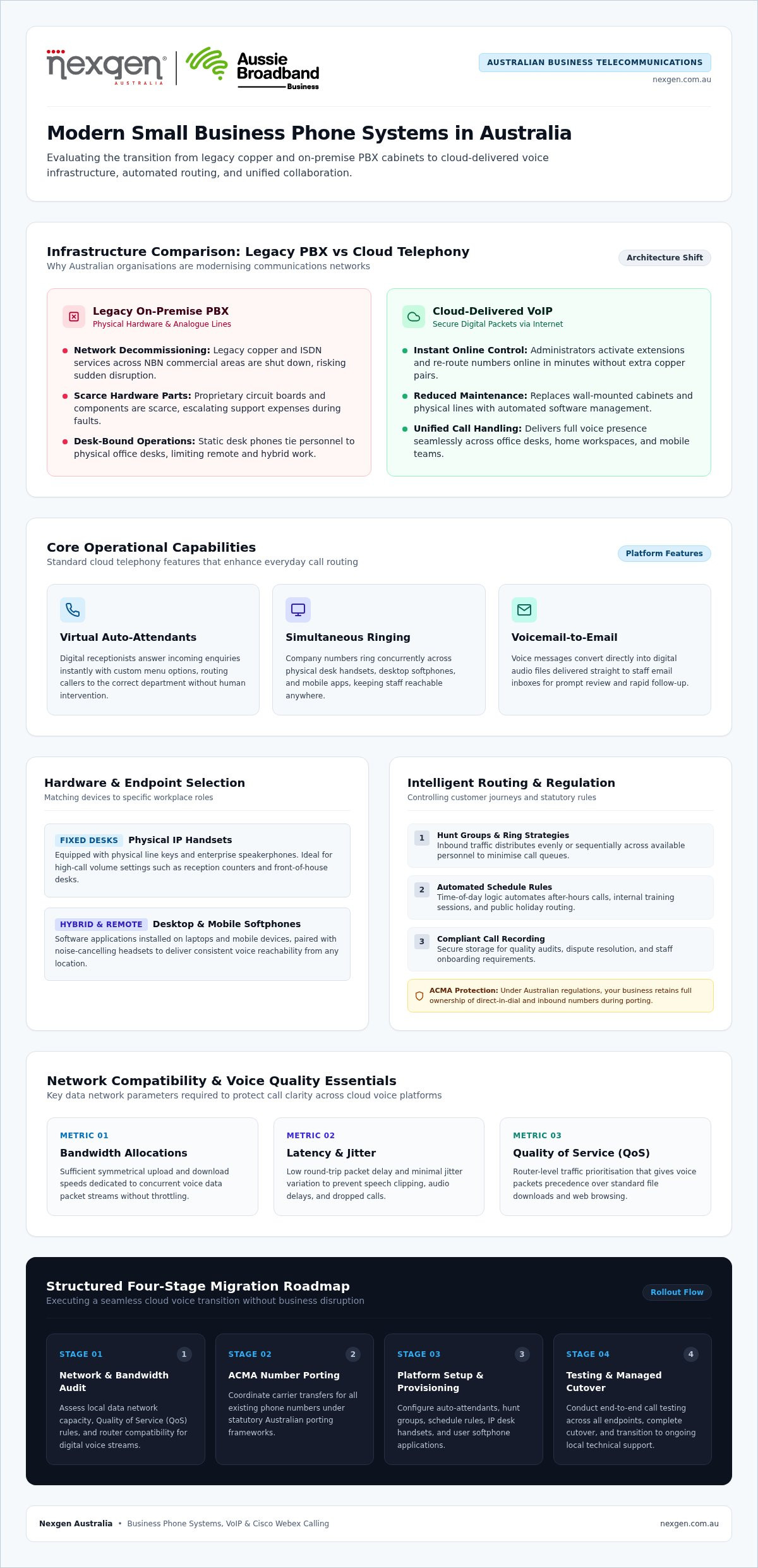
Cloud VoIP converts spoken voice into secure digital data packets, transmitting calls over an internet connection rather than physical telephone lines. For Australian organisations evaluating modern business telephone systems, this architecture eliminates dependence on wall-mounted hardware cabinets and dedicated copper pairs. The transition from legacy infrastructure to modern small business phone systems Australia wide delivers operational flexibility, lower maintenance complexity, and unified call handling across distributed teams.
The Operational Risks of Legacy Phone Systems
On-premise PBX cabinets represent a growing operational liability for Australian workplaces. Replacement circuit boards and proprietary manufacturer components have become increasingly scarce, driving up support expenses each time a hardware fault occurs. Worse still, legacy copper and ISDN connections across NBN-served commercial districts are almost completely decommissioned. Remaining legacy services face sudden disconnection, creating severe commercial exposure for organisations that rely on analogue trunk lines to take inbound sales calls. Static desk phones also anchor staff to specific office desks, preventing remote and hybrid personnel from managing company calls efficiently.
Core Operational Advantages of Cloud-Delivered Voice
Upgrading to cloud-hosted infrastructure replaces physical limitations with automated software control. Rather than leasing extra copper pairs, administrators can activate extensions or re-route numbers through an online portal within minutes. Key capabilities include:
- Virtual auto-attendants: Automated digital receptionists answer incoming enquiries instantly, presenting custom menu options that direct callers to the right department without human intervention.
- Simultaneous ringing: Company numbers ring concurrently across physical desk handsets, desktop software, and smartphone applications, ensuring client calls reach available team members regardless of their working location.
- Voicemail-to-email: Voice recordings convert into digital audio files delivered straight to team inboxes, allowing staff to review and action urgent customer requests promptly.
Adopting unified small business phone systems Australia wide ensures your business voice presence remains resilient, accessible, and ready for modern operational demands.
Key Selection Criteria: Evaluating Business VoIP and Cloud Handsets
Selecting a communications platform requires looking past promotional call packages to evaluate practical day-to-day usability. The most effective small business phone systems Australia provides balance physical hardware durability with software flexibility, ensuring your team remains reachable without managing bloated IT infrastructure.
Hardware Flexibility: IP Desk Phones versus Softphones
Modern deployments rarely rely on a single device type. High-volume environments like reception counters and front desks benefit from dedicated IP desk handsets featuring physical line keys and enterprise speakerphones. Conversely, hybrid and mobile staff perform better with intuitive softphone applications installed on laptops and smartphones. Equipping remote team members with dedicated noise-cancelling headsets alongside softphone apps delivers a consistent office presence anywhere with an active internet connection.
Intelligent Inbound Call Routing and Queue Management
Customer frustration escalates quickly when inbound calls sit unanswered or bounce across multiple departments. Look for platforms that offer:
- Hunt groups and ring strategies: Inbound traffic distributes evenly or sequentially across available staff to prevent bottlenecks.
- Automated schedule rules: Time-of-day routing handles after-hours enquiries, staff training sessions, and public holiday closures without manual intervention.
- Compliant call recording: Built-in storage tools securely record customer interactions for quality audits, dispute resolution, and staff onboarding.
Under statutory protections and ACMA guidelines on number porting, your company retains full ownership of your published direct-in-dial and inbound numbers during these system improvements.
Platform Integrations and Unified Collaboration
Evaluating modern business communications means examining how voice connects to the rest of your operating stack. Unified platforms combine voice telephony, team messaging, and high-definition video conferencing into a single interface, eliminating fragmented software licences. Synchronising your phone platform with customer relationship management (CRM) software automates call logs and triggers instant screen-pop notifications. Staff gain immediate context on client histories before even answering the line. When reviewing unified small business phone systems Australia decision-makers can consult Nexgen Australia to identify the ideal balance of hardware endpoints and software integrations for their organisation.
Assessing Network Compatibility and Voice Quality Requirements
Voice clarity over IP networks depends far more on network stability than raw download speed. When deploying modern small business phone systems Australia organisations rely on, three critical metrics determine call quality: latency, jitter, and packet loss. Latency represents the delay between words spoken and heard, which should remain under 150 milliseconds. Jitter measures irregular timing in packet delivery, ideally staying below 30 milliseconds. Packet loss occurs when data drops during transmission, and keeping it below 1% prevents clipping and garbled audio.
A reliable business VoIP call requires roughly 80 to 100 kilobits per second (kbps) of symmetrical bandwidth for uncompressed audio, dropping to between 30 and 64 kbps when utilising high-efficiency compression codecs.
Bandwidth Capacity and High-Definition Audio Codecs
Modern audio codecs deliver high-definition sound while consuming modest amounts of bandwidth. The operational friction point rarely stems from voice file size. Instead, it stems from asymmetric data connections where limited upload headroom gets congested by cloud backups and large email attachments. Consulting ACCC broadband performance data confirms that standard retail connections often experience throughput dips during peak business hours. Conducting a comprehensive pre-deployment network audit guarantees your connection maintains adequate symmetrical speed for your total concurrent call volume.
Router Configuration and Power over Ethernet Switching
Local network equipment directly affects voice transmission reliability. Disabling SIP Application-Level Gateway (SIP ALG) on office firewalls prevents packet corruption, resolving frequent causes of one-way audio and dropped calls. Additional local network optimisations include:
- Quality of Service (QoS) prioritisation: Router-level QoS tags voice packets as high-priority, allowing active calls to move ahead of file downloads and general web browsing.
- Voice VLAN segregation: Isolating business telephony onto a dedicated virtual network prevents internal file transfers and printing traffic from interfering with real-time conversations.
- Power over Ethernet (PoE) switches: PoE switches deliver operating electricity and high-speed data across a single network cable, removing unsightly power bricks from staff workstations.
Properly preparing your local switching and routing infrastructure ensures your chosen small business phone systems Australia wide deliver consistent, carrier-grade clarity on every client conversation.
Step-by-Step Migration Roadmap: Transitioning Your Office Phone System
Transitioning your voice platform doesn’t have to interrupt trading or leave customers stranded on dead lines. Executing a phased rollout ensures your business maintains active communications while configuring and testing new infrastructure in parallel. For organisations upgrading to modern small business phone systems Australia wide, following a disciplined deployment roadmap protects customer accessibility from day one.
Number Porting and Compliance Under ACMA Regulations
Retaining your published local numbers and 1300 or 1800 contact points is vital for brand continuity. Australian Communications and Media Authority rules guarantee your statutory right to port telephone numbers between carriers. To prevent administrative rejections, collect recent carrier invoices showing your exact account name, service address, and Complex Service identifiers. Most importantly, keep your legacy contracts active throughout the migration process. Cancelling an account prematurely forfeits your numbers before the porting cutover completes.
Call Flow Architecture and Professional Audio Configuration
Visualise and document your call routing paths before programming your platform:
- Extension allocation: Assign specific direct-in-dial numbers, hunt group sequences, and overflow rules across departments.
- Custom voice prompts: Record clean, professional auto-attendant greetings that guide callers quickly to the correct team.
- Disaster recovery failover: Configure automated emergency rules that instantly divert calls to backup mobile numbers if local office power drops out.
Team Onboarding and Day-One Launch Procedures
System adoption depends heavily on staff confidence during the first working hours. Deliver pre-configured desktop software and plug-and-play IP handsets across workstations several days before scheduled cutovers so staff can test audio devices. Practical training should focus on daily tasks such as warm call transfers, queue toggles, and voicemail management. Monitor real-time platform logs throughout the initial week to refine queue ring timers and support staff questions as they arise.
A structured approach eliminates stress and keeps your operations trading without friction. If you’re ready to upgrade your business communications without technical headaches, speak with the voice specialists at Nexgen Australia to coordinate your migration plan.
Deploying Managed Voice Solutions with Nexgen Australia
Modernising your company’s communications shouldn’t force business leaders to become telecommunications engineers. While many retail internet providers leave customers to configure their own cloud extensions and call routing, Nexgen Australia delivers fully managed cloud phone systems and tailored small business VoIP solutions engineered for operational simplicity. As an official deployment partner for advanced cloud calling systems across Australia, Nexgen Australia pairs enterprise-grade collaboration tools with carrier-grade reliability. When evaluating modern small business phone systems Australia wide, choosing a fully managed deployment ensures your voice platform is designed around your exact commercial workflow.
Enterprise Cloud Telephony Tailored for Growing Teams
Nexgen Australia delivers cloud phone infrastructure engineered specifically to support modern hybrid workplaces. Integrating feature-rich cloud calling allows your organisation to consolidate business voice, team messaging, and virtual meeting spaces into one straightforward interface across computers and mobile handsets. This managed model eliminates unpredictable on-premise maintenance agreements and hardware obsolescence, replacing them with a scalable operational structure that expands effortlessly as your head count grows.
End-to-End Onboarding and Dedicated National Support
Operating as a dedicated B2B telecommunications specialist, Nexgen Australia combines national network dependability with attentive, consultative service. Your business avoids impersonal offshore call centres and frustrating ticketing queues. Key onboarding and support advantages include:
- Custom call flow architecture: Experienced voice specialists build your multi-level auto-attendants, hunt groups, and schedule routing to match your operating hours.
- Carrier coordination: Dedicated voice engineers oversee number porting compliance from start to finish, preventing downtime and protecting your published contact numbers.
- Responsive local technical care: Access responsive Australian business support for rapid adjustments to extensions, user licences, and audio prompts as your needs evolve.
Transitioning to modern voice infrastructure protects customer relationships, enhances team collaboration, and positions your organisation for continuous growth. Arranging a consultation with Nexgen Australia provides a clear roadmap to evaluate your current setup, design an effective voice environment, and deploy the right phone system for your business.
Taking the Next Step Toward Agile Business Telephony
Upgrading your telecommunications infrastructure transforms business voice from a fragile hardware burden into a dynamic operational asset. By auditing network bandwidth, mapping logical call flows, and following statutory number porting rules, you can eliminate dropped calls and empower hybrid staff without risking downtime. A modern communications platform ensures your team projects a unified, professional presence on every customer interaction.
When evaluating small business phone systems Australia wide, your organisation deserves a communications partner that pairs proven technology with dependable local care. Operating as a dedicated B2B telecommunications subsidiary of Aussie Broadband Limited, Nexgen Australia provides tailored business phone systems backed by specialised Australian technical support. As an authorised provider delivering advanced Cisco Webex Calling phone systems, Nexgen ensures your staff enjoy carrier-grade reliability and straightforward collaboration wherever they work.
Upgrade your business communications with Nexgen Australia today and equip your team with the tools to connect, collaborate, and grow with confidence.
Frequently Asked Questions
Can our business keep our existing telephone numbers when moving to a cloud phone system?
Yes, Australian businesses have a statutory right to port all existing local numbers, 1300 numbers, and 1800 numbers to a new provider. ACMA regulations protect number portability across carriers. To ensure a smooth migration, keep your current telco account active until the porting process finishes. Nexgen coordinates the regulatory transfer with your current carrier, ensuring your customers experience uninterrupted phone access during the changeover.
How many simultaneous phone calls can our small business make over an internet connection?
Your concurrent call capacity depends directly on your internet connection’s symmetrical bandwidth. A standard uncompressed VoIP call uses about 80 to 100 kbps, while compressed calls need around 30 to 64 kbps. A typical business broadband link with 20 Mbps upload can comfortably handle over 50 simultaneous calls alongside daily cloud tasks, provided you apply Quality of Service settings to prioritise voice traffic.
What happens to our incoming customer calls if our office internet experiences an outage?
Incoming calls route automatically to predefined disaster recovery paths so your business never goes dark. Because cloud systems run in carrier data centres rather than on-premise hardware, an office outage won’t take down the platform. Calls instantly divert to staff mobile apps, secondary backup locations, or dedicated external numbers. Once local connectivity restores, standard office routing resumes immediately without manual adjustments.
Are cloud phone systems suitable for staff working remotely or travelling across Australia?
Cloud phone systems are purpose-built for hybrid and travelling personnel across the country. Staff can install business softphone apps like Cisco Webex Calling on laptops and mobile devices, keeping their primary office extension with them wherever they have internet access. Outbound calls present your standard corporate number, preserving professional consistency while enabling employees to collaborate and answer inbound queues from anywhere.
Do we need brand new desk handsets, or can staff use computer softphones and headsets?
You do not need physical desk handsets for every workstation. Modern small business phone systems Australia organisations deploy allow teams to use computer software, mobile apps, or high-definition USB headsets instead. While reception desks and executive suites often prefer dedicated physical IP phones, remote and mobile workers operate effectively using softphone apps, reducing upfront equipment investments significantly.
What is the difference between business VoIP solutions and consumer calling apps?
Business VoIP platforms deliver enterprise-grade call management features that consumer applications simply cannot match. Unlike basic messaging apps, dedicated systems provide multi-level auto-attendants, hunt groups, compliant call recording, and direct CRM integrations. They also comply with Australian emergency Triple Zero obligations and provide authenticated caller ID overstamping, ensuring your outbound calls aren’t flagged as spam by local mobile carriers.
What network preparations should our business complete before installing a VoIP phone system?
Before deploying small business phone systems Australia wide, test your broadband link for stable latency under 150 milliseconds and packet loss below 1%. Ensure your router supports Quality of Service prioritisation and that SIP ALG is disabled to prevent dropped audio. Installing Power over Ethernet switches will also supply power to physical handsets directly through data cabling, simplifying desk installations.