

The short answer
A phone system for automotive businesses has to route service, parts and sales calls to the right person, often while staff are away from a desk or under a car. A cloud-based system keeps working across more than one site and gives you a record of what was missed during a rush. For a workshop or dealership with 3 to 20 handsets, that usually means fewer lost bookings and less time spent returning messages.
On this page
For a law firm, the phone is where a new client decides whether to call the next name on the list. For an automotive workshop, it is where a booking either goes in the diary or goes to the workshop down the road, which is why phone systems for automotive businesses need to work differently from a typical office setup.
The trade runs on the phone more than most. A customer rings to book a service, rings again to ask if it is ready, and rings a third time about a strange noise that started on the drive home. Multiply that by a parts counter, a sales floor and a body shop, and a single receptionist or a phone sitting on a bench in the workshop stops being enough.
Why does a busy automotive workshop lose bookings over the phone?
Because the caller rarely waits. If the service desk is busy, the phone rings out, and the person on the other end calls the next workshop in their search results rather than leaving a voicemail. The job that would have filled a bay on Thursday goes to a competitor instead, and nobody at the business ever finds out it happened.
This is a bigger risk in a trade where the Motor Trades Association represents more than 15,000 Australian automotive retailers competing for the same local customers. A shop that only answers calls when the front desk is free is relying on timing it cannot control.
What makes phone traffic different in an automotive business?
Most office phone traffic comes from people sitting at a desk. Automotive phone traffic comes from people standing at a parts counter, leaning into an engine bay, or walking a customer around a car on the lot, which is a different problem to solve.
A few things come up again and again when a workshop or dealership looks at replacing its phones:
A cloud-based system is not what fixes any of this by itself. What matters is whether the system can route a call to whichever team is actually free, rather than ringing out on one handset while three other staff stand nearby.
Can one phone system handle an automotive business’s service desk, parts counter and sales floor at once?
Yes. A hosted system can usually be set up with a separate number or extension group for service, parts and sales, so a call lands with whichever team it is for instead of one shared front desk. Calls to a busy team can ring several handsets at once or queue to the next free person, rather than ringing out.
That matters more as a business grows. These are the reasons we most often hear from businesses replacing an older phone setup: rising costs on an ageing system, poor call quality that makes customers repeat themselves, growth that has outpaced what the current phones can handle, too many separate tools for calls and messages, and no visibility into how many calls are being missed. An automotive business with a growing service bay or a second location tends to hit several of these at once.
What happens when every technician is busy or under a car?
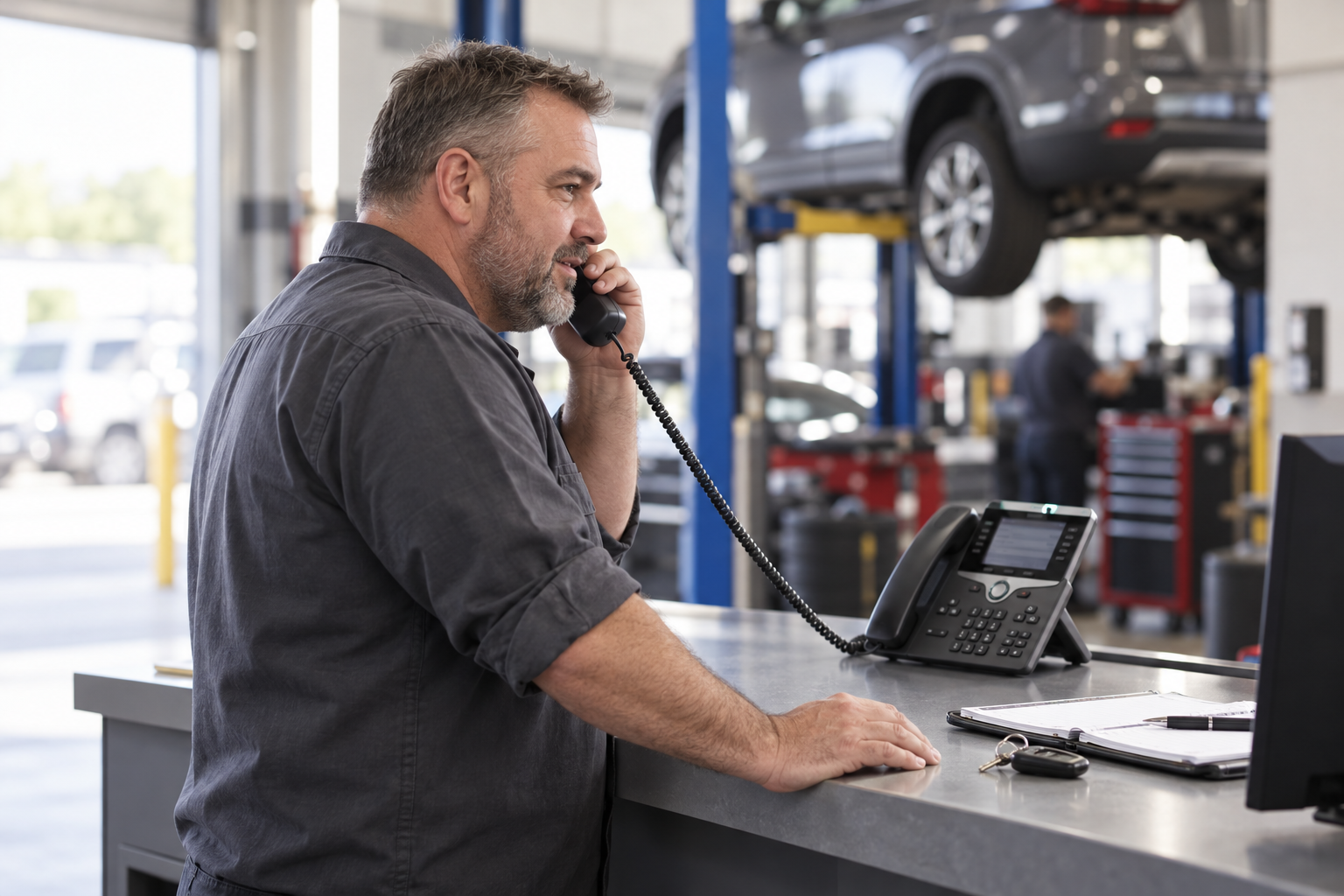
Picture the service desk on a Monday morning: every bay is full, the only free set of hands is covered in grease, and the phone is already on its fourth ring. In a lot of workshops, that call either goes to voicemail, rings out, or gets picked up by whoever is nearest, which is not always the right person to answer it.
None of those outcomes gives the caller confidence that the job is being taken seriously.
A better default is a short recorded message that tells the caller their options: hold for the next available person, leave a message that reaches the right inbox, or call back during quieter hours. It will not win back every call, but it is a better experience than silence or a ring-out, and it is one of the more useful changes a workshop can make without changing how anyone actually works.
Do multi-site automotive dealer groups need a different phone system from a single workshop?
Generally, yes. A dealer group is a different problem from a single workshop with one phone line, because customers and internal staff both need to reach the right site without knowing which number to dial.
The scale involved is real. The Automotive Dealer Association represents close to 3,943 dealerships nationally, many of them running service, parts and sales as distinct departments across more than one location. A system that links sites under shared extensions means a customer can be transferred from one yard to another without being given a second phone number to call, and head office can see call activity across every site rather than one at a time.
Is it safe to take card details over the phone for parts or service work?
It can be, but the risk is not the phone system itself. It is a scam caller impersonating a supplier, a customer or even your own business to get a payment redirected or a card number read out.
ASD’s small-business guidance is blunt about this: scam attempts arrive by phone call as often as by email, and the safest response to an unexpected request to change a payment or bank account is to verify it through a number you already know, not one given to you in the call or message itself. A parts counter that takes supplier calls every day is a realistic target. We cover the technical settings that reduce toll fraud and spoofed calls in more detail in our guide to VoIP call security.
What should your phones do over a long weekend or public holiday?
Picture a long weekend: the workshop is shut for three days while half the customer list is driving to the coast and back, and a few of those cars will need a once-over before they leave. A workshop that shuts for a long weekend still gets calls from people booking a pre-trip check or chasing a job that was due back, and public holidays tend to cluster demand into the days either side of the closure.
Close the phones properly, on purpose, rather than leaving the regular voicemail running.
A message that states the return date and an emergency contact for genuine breakdowns does more for customer confidence than a generic “we are currently unavailable” message running all year. We have a step-by-step version of this for the Christmas and New Year period in our closure message guide.
Will the team still be reachable in a genuine emergency if the business moves to a cloud phone system?
Yes, with one detail worth checking first. Triple Zero (000) can be reached from certain VoIP services, but the emergency call service relies on the address registered against each number to send help to the right place.
For a single-site workshop this is a formality. For a multi-site dealer group it is not: a handset at a second yard needs its own correct address on file, not the head office address inherited from the main number. It is worth confirming directly with whoever sets up the system, rather than assuming it carried across automatically.
Does recording a customer call raise privacy questions for an automotive business?
It can, depending on the size of the business. Many independent workshops sit under the $3 million threshold that generally exempts a small business from the Privacy Act, but a related entity, a franchise arrangement or a business that opts in can bring it back into scope.
A recorded call authorising extra work, or confirming a price before a repair starts, is genuinely useful if a job is ever disputed. We look at the legal side of recording calls, which varies by state, in our separate guide on call recording law rather than repeating it here.
None of this requires a different phone system for every department. It requires one system that can tell a service call from a parts call from a sales call, keep working the same way across every site, and leave a record of what happened while everyone was flat out. NexGen has worked with Australian businesses for 17 years, including workshops and dealer groups in the 3 to 20 handset range, and is rated 4.8 stars from 1,900+ Google reviews. Standard onboarding takes 7 business days.
Ready to stop losing bookings to a busy line?
See how a NexGen phone system fits a workshop or dealership with 3 to 20 handsets.