

The short answer
VoIP lets you make and receive phone calls through an internet connection instead of a traditional phone line. Your voice is converted into small digital data packets, sent across the internet, then converted back into sound at the other end.
On this page
If you are asking how VoIP works in plain English, the short version is this: VoIP turns your internet connection into a phone service. You can still use a familiar number, desk phone and business features such as voicemail, call transfer and an automated receptionist.
What is a VoIP phone system?
A VoIP phone system is a business phone service that carries calls over an internet connection. It can connect desk phones, computers, tablets and mobile apps to the same business number and call platform.
The term VoIP means “Voice over Internet Protocol” — making calls over the internet rather than over traditional phone lines.
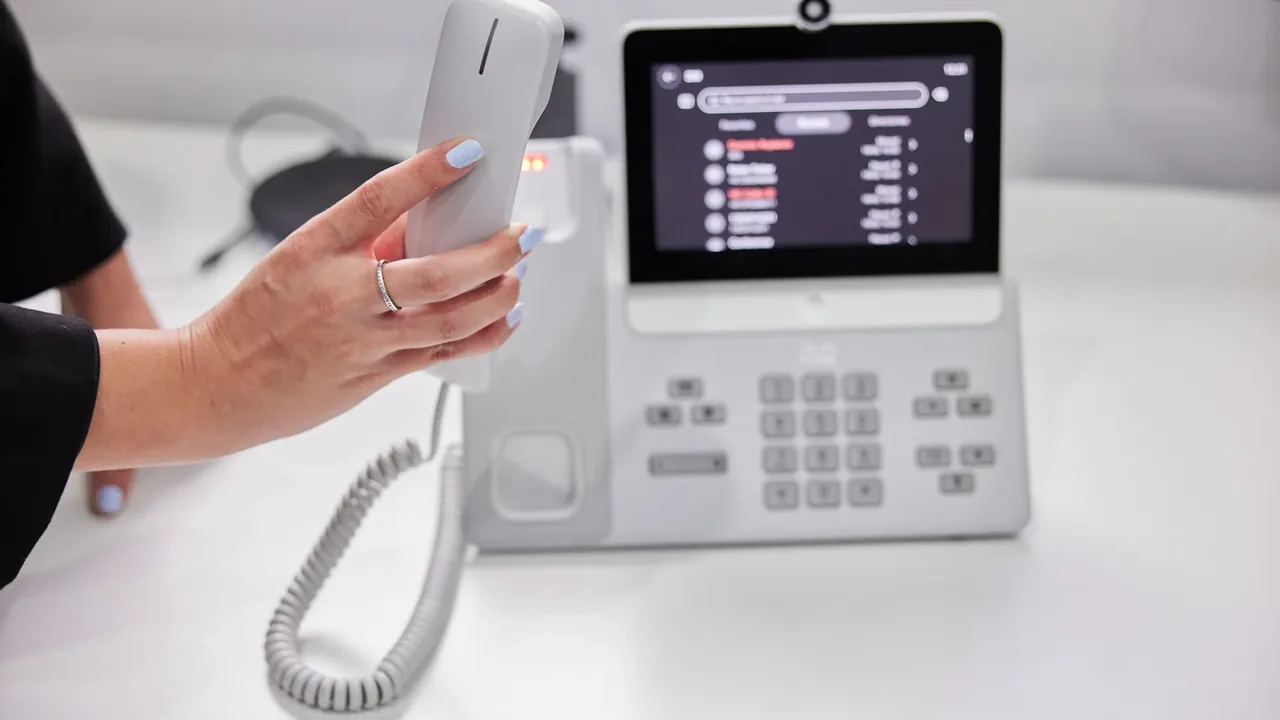
The phone on your desk may look much like a traditional phone. The difference is what happens behind it: instead of sending voice through a dedicated phone line, it sends voice as data through your internet connection.
You can learn more about the difference between the service and the hardware in this guide to VoIP phone systems.
How does VoIP work when you make a call?
When you make a VoIP call, the system completes five basic jobs: it captures your voice, converts it into data, finds the destination, sends the data and turns it back into sound.
Think of it like sending a spoken message through a courier network. Your voice is divided into many small parcels, each parcel is labelled and sent across the network, then the receiving phone puts the parcels back together in the right order.
The process in plain English
The call may travel entirely between two internet-based systems. Or it may pass through a gateway that connects your VoIP service to a mobile or fixed-line network. That is why you can call an ordinary mobile or landline number from a VoIP phone.
Does VoIP use the internet for the whole call?
Not always. VoIP uses the internet for the part of the call handled by the VoIP service, but the call may connect to a mobile or fixed network before it reaches the other person.
For example, a call from your VoIP desk phone to another user on the same system may stay within the provider’s internet-based network. A call to a customer’s mobile may travel from your phone to the provider over the internet, then move onto a mobile network.
This is why the person receiving your call does not need to use VoIP. They can answer on a mobile, landline, desk phone or another internet phone system.
The same principle works in reverse. When a customer calls your business number, the telephone network passes the call to your VoIP provider. The provider then sends it to the right person, extension, queue or app.
What happens inside a business VoIP system?
A business VoIP system acts like a digital switchboard. It decides where calls should go and what should happen when nobody answers.
The system follows rules set for your business. Those rules are managed in software rather than through a large phone exchange installed at your premises.
This is the main idea behind a cloud VoIP phone system: the phone system is hosted and managed through a provider’s platform, while your staff use connected phones or apps.
The technical terms can sound complicated, but the business result is straightforward. Your number, users, call flows and phone features are managed in one system.
Is a VoIP phone the same as a normal desk phone?
A VoIP phone can look and feel like a normal desk phone, but it sends calls through a network connection rather than a traditional telephone line.
| Phone type | How it carries the call | What the user normally notices |
|---|---|---|
| Traditional landline phone | Dedicated telephone network | Familiar handset and phone number |
| VoIP desk phone | Internet or business network | Similar handset, with software-based features |
| Softphone app | Internet connection through a computer or mobile | Calls handled through an app |
| Mobile phone call | Mobile carrier network | Uses the mobile network and mobile plan |
| Messaging app call | Internet connection through the app | Calls stay inside that app’s service |
A VoIP phone is not necessarily a computer. It can be a purpose-built handset with a screen, keypad and handset, designed for business calling.
A softphone is different. It is an app that turns a computer, tablet or mobile device into a phone. Your team can use the same business identity across supported devices, depending on the service and permissions you choose.
Why use VoIP instead of a cell phone?
Businesses often use VoIP instead of relying only on mobile phones because VoIP is designed around a shared business phone system, not one person’s handset. The main difference is control. A mobile phone usually belongs to one employee. A VoIP number can be connected to a team, queue, receptionist, voicemail box or several devices.
| Business need | Relying mainly on mobile phones | Using a business VoIP system |
|---|---|---|
| Main business number | Often linked to one person | Can ring a team or call flow |
| Staff changes | Number and history may stay with an employee | Users and access can be managed centrally |
| Reception and queues | Usually limited or manual | Can be handled by software |
| Remote work | Depends on individual mobiles | Business calls can use apps or supported devices |
| Call visibility | Often spread across separate phones | Can be managed through one system |
| Business hours | Usually manual forwarding | Can follow scheduled rules |
| Customer experience | Depends on who answers | Can use menus, queues and consistent routing |
VoIP does not automatically replace every mobile phone. Mobile phones still matter when staff work outside reliable internet coverage or need a separate personal work mobile.
Does your business need a shared phone system, or a collection of individual phones?
That is the useful question — not whether VoIP is always better than mobile. For the broader business decision, see is VoIP worth it for small business?
Does VoIP work if the internet goes down?
A VoIP call needs a working path between your device and the VoIP service. If your internet connection or local power fails, the phone may not be able to make or receive calls from that device.
That does not mean every VoIP service has to stop during every local problem. Providers may offer call forwarding, mobile apps, alternate locations or other continuity options. The exact behaviour depends on the service design and the failover options included.
The important point is that call quality depends on the network carrying the voice data. Delay, congestion, packet loss and unstable connections can all affect what people hear.
Is WhatsApp VoIP?
Yes. WhatsApp voice and video calls are examples of internet-based calling, which means the audio travels through an internet connection rather than a traditional phone call path.
WhatsApp calls are different from a business VoIP phone system in how they identify users and manage calls. WhatsApp generally uses accounts and contacts inside the app, while a business VoIP system usually provides business numbers, extensions, call routing and links to regular telephone networks.
So the simple answer is yes — but WhatsApp is not automatically a replacement for a business phone system.
How can you tell if someone is using VoIP?
Usually, you cannot tell just by listening to the call or looking at the number. A VoIP call can sound and appear much like a mobile or landline call.
Treat line-type information as an indicator, not a way to identify a person. It also should not be used on its own to decide whether a caller is trustworthy.
Can VoIP call emergency services in Australia?
Some VoIP services can call Triple Zero, but not all VoIP services work in exactly the same way. Confirm emergency-call access, location handling and backup arrangements with your provider before relying on the service.
For a business, this is a practical service question worth asking during assessment. Do not assume that every internet calling app, softphone or provider has the same emergency-call capability.
What is the simplest way to understand how VoIP works?
Think of VoIP as a courier service for your voice. Your phone turns speech into small digital parcels, the internet carries those parcels, and the other phone turns them back into speech.
The business phone system acts like the dispatcher. It knows which number was called, which staff member should answer, what to do after hours and where to send the call if nobody picks up.
That is the core of how VoIP works. The handset is only one part; the internet connection, call-control software and provider network all work together.
What do business owners still ask about VoIP?
Is VoIP the same as calling over Wi-Fi?
VoIP means voice is carried using internet protocol, while Wi-Fi is only one way a device may connect to the internet. A VoIP call can use Wi-Fi, Ethernet, mobile data or another internet connection.
Do I need a special phone for VoIP?
You may use a VoIP desk phone, a computer app, a mobile app or another supported device. The right option depends on how your business wants staff to answer and manage calls.
Can I keep my existing business number with VoIP?
Number portability may allow you to move an existing number to a VoIP provider. The process and eligibility depend on the number, provider and service type, so confirm this before changing services.
Is VoIP only for large companies?
No. A small business can use VoIP for a main number, extensions, voicemail and call forwarding without running a large onsite phone exchange. A cloud phone system can also grow as your team and calling needs change.
Want VoIP set up without the tech headache?
Nexgen handles the numbers, the call flows and the connection so you only deal with the phone.