


A recording announcement is a sensible start, but it doesn’t automatically settle every legal obligation. That’s the key point behind acma regulations for commercial call recording consent: ACMA oversees federal telecommunications rules, but it doesn’t set one simple national consent rule for every business call.
If you’re unsure how federal requirements interact with state and territory laws, you’re not alone. The rules can depend on who’s recording, where the participants are located and how the recording will be used. A notice can inform callers and support consent, but your business may also need to consider privacy, access and retention.
This article explains ACMA’s role and why state and territory surveillance laws often have a more direct bearing on business call recording. It also outlines the issues that call for current, jurisdiction-specific legal advice and how to create a practical recording policy your staff and phone-system workflows can follow. The aim is to help you understand your responsibilities, not to treat a standard announcement as a complete compliance solution.
Key Takeaways
- acma regulations for commercial call recording consent are only part of the picture. Assess the federal, state and territory rules relevant to your calls.
- Map the purpose of each recording. Consider who is speaking, where participants are located and whether overseas callers are involved.
- Separate legal review, staff training, caller notices and decisions about recording access and retention in your process.
- Document how your phone system should support the approved policy, including when recording starts and who manages recordings and deletion.
- Review the policy when your business, call practices or applicable laws change. Seek jurisdiction-specific legal advice where needed.
What do ACMA regulations mean for commercial call recording consent?
ACMA doesn’t set one blanket consent rule for every Australian business call. The acma regulations for commercial call recording consent are only part of a wider legal picture. Your business needs to consider the call’s purpose, who is speaking, where participants are located and which federal, state, territory and privacy rules may apply.
Commercial call recording means capturing the audio of a business conversation, such as a customer-service call or a discussion with an employee. That’s different from monitoring other communications, such as reviewing emails, messages or network activity. Those activities can raise separate legal and workplace questions, so don’t treat a phone-recording policy as a policy for all workplace monitoring.
What role does ACMA play in call recording?
ACMA is Australia’s communications regulator, with responsibilities connected to federal telecommunications laws. The Telecommunications (Interception and Access) Act 1979 concerns the interception of communications over telecommunications systems. This federal framework is distinct from state and territory surveillance-device laws, which may also be relevant to recording conversations.
ACMA’s role doesn’t replace an assessment of the laws that apply to your specific call. Nor should you read ACMA material written for broadcasters as a universal consent standard for businesses. Broadcaster guidance has a narrower context. You can’t determine the rules for recording a customer conversation simply by finding an ACMA notice or adopting a standard announcement.
Why does a business need to identify the call’s context?
The reason for recording affects the questions your business should ask. A customer-service recording may support service review; a training recording may be used to coach staff; and a dispute-resolution recording may preserve details of an interaction. Staff monitoring raises additional workplace considerations, including how employees are informed and how recordings are used.
Before recording, define the purpose and make sure the proposed use matches it. For example, a recording collected for training shouldn’t automatically be used for unrelated performance monitoring. Privacy obligations may also affect how personal information in a recording is handled, stored, accessed and retained.
A generic script alone can’t establish that a recording is lawful. A notice may tell callers that recording is taking place and explain why, but the legal assessment can still depend on the participants, their locations, the recording method and the current legislation. Calls involving people in different Australian jurisdictions, or overseas participants, may need closer review.
This section provides general information, not a legal determination for an individual business. Before implementing a recording policy, obtain current, jurisdiction-specific legal advice on how the relevant rules apply to your organisation and call practices.
Which Australian laws can affect commercial call recording consent?
No single statute answers every consent question. The relevant framework for a business recording a call can include federal telecommunications interception law, the surveillance or listening-device laws of one or more states or territories, and privacy obligations governing personal information in the recording. Each layer addresses different issues. Assess them separately rather than relying on one announcement or regulator as a complete compliance check.
How does federal telecommunications law fit in?
The Telecommunications (Interception and Access) Act 1979 is the federal law to consider when assessing the interception of communications carried over a telecommunications system. In plain English, the central question is whether a communication is being intercepted in transit and what the circumstances mean under the Act. The answer can turn on the facts, including how the call is captured, so it needs careful legal interpretation rather than a broad assumption about all business recordings.
ACMA’s telecommunications role doesn’t mean that an ACMA approval or a standard call announcement resolves every federal issue. Federal law also doesn’t replace state and territory rules about recording private conversations. For a specific recording practice, review the current Act and obtain legal advice if its application is uncertain.
Why check state, territory, and privacy requirements?
Surveillance-device and listening-device laws are set at state and territory level, and their wording and exceptions differ. Identify where the relevant people are located and check the legislation for the jurisdictions involved: New South Wales, Victoria, Queensland, Western Australia, South Australia, Tasmania, the Australian Capital Territory and the Northern Territory. Don’t infer the rule for one jurisdiction from another or assume one national script settles every case.
Use the official legislation website for each jurisdiction to check the current Act, amendments and any applicable exceptions. This is particularly relevant if your business takes calls across state borders, records staff conversations or changes how recordings are used. A legal adviser can help interpret provisions that are difficult to apply to your actual call workflow.
Privacy is another layer. A recording may contain personal information, such as a caller’s name, contact details or account information. The Privacy Act 1988 and Australian Privacy Principles may govern how covered organisations collect, use, disclose, secure and retain that information. Coverage depends on the organisation and its circumstances, so don’t assume every business has the same obligations. The Office of the Australian Information Commissioner (OAIC) provides guidance on the Privacy Act and the APPs. Check its current material alongside the legislation.
For a practical review, list the call types you record, the people involved, the jurisdictions connected to those calls and the intended uses of each recording. That gives your legal adviser a clear picture to assess. Once the policy is approved, business phone-system planning can help align the intended call workflow with the approved process, while legal advice addresses the rules that apply.
How do consent, call purpose, and caller location change the analysis?
Consent can’t be assessed from the announcement alone. The call’s purpose, who is speaking, where each participant is located, what they’re told and how the recording will later be used can all affect the questions your business needs to resolve. Use the scenarios below to identify what needs review, not to assume a single consent outcome.
| Call scenario | Questions to assess |
|---|---|
| Customer service | What is the recording for? Are callers told that purpose before recording begins? Could the recording capture personal or sensitive information, and how will it be used? |
| Staff calls | Are employees aware of the recording and its intended use? Is it for coaching, quality review or another purpose? Could workplace policies or employment considerations also apply? |
| Participants in different Australian jurisdictions | Where are the caller and employee located? Which state or territory laws may be relevant? Does the business process account for calls where participants are in different jurisdictions? |
| Overseas participants | Where is each participant located, and could rules outside Australia apply? Has the business obtained advice on the relevant jurisdictions before using one recording workflow? |
These distinctions matter because a call recorded for service improvement may later be requested for a dispute or used in staff performance discussions. A change in purpose can raise new privacy or workplace questions. Your policy should explain why calls are recorded and set clear limits on access and further use.
Does saying the call may be recorded settle consent?
No. An announcement can provide notice, but it doesn’t automatically prove that any consent required by applicable law has been obtained. A clear notice should explain that recording is occurring, why the business is recording and what a caller can do if they don’t wish to proceed, such as asking about an alternative. Whether that process is legally sufficient depends on the circumstances and current law.
Don’t treat a familiar script as a universal solution. The phrase “this call may be recorded” may not tell a caller the purpose or offer a practical response. Have the wording and process assessed for the call types and jurisdictions your business handles.
What changes when calls cross state or national borders?
People on the same call may be subject to different rules because they’re in different jurisdictions. A business-wide policy should account for caller and staff locations, including remote workers and overseas callers, rather than relying only on the location of its head office. Get jurisdiction-specific legal advice before using one workflow for cross-border calls.
In practice, the acma regulations for commercial call recording consent don’t remove the need to examine each scenario. Record the call’s purpose, participant locations, notice provided and intended uses in your policy design. This gives your legal adviser a concrete process to review and helps your team apply the approved approach consistently.
How can a business build a practical call recording consent process?
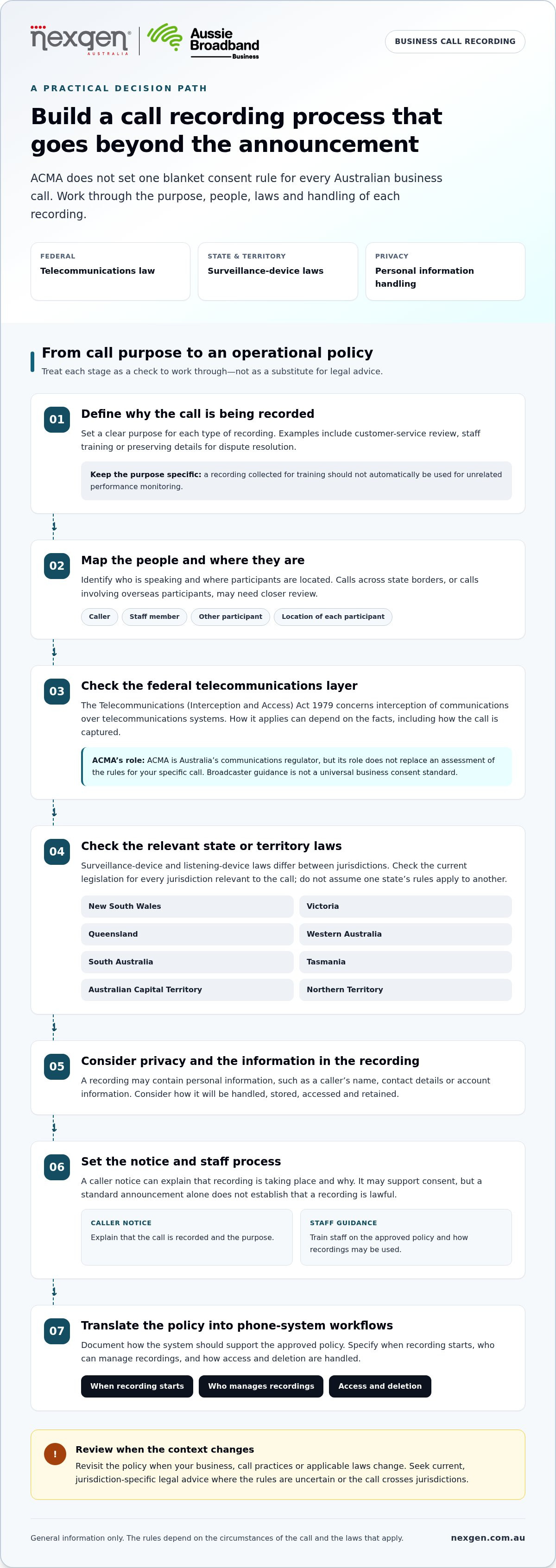
A workable process connects your approved policy to what staff do on each call and how recordings are handled afterwards. Use this workflow to make responsibilities clear, then have a legal adviser assess the policy against your business and the jurisdictions involved.
- Define the purpose. Identify which call types you plan to record and why, such as customer-service review or staff training. Don’t treat one purpose as automatic approval for every call or later use.
- Obtain legal review. Give your adviser the call types, participant locations, recording method, proposed notice and intended uses. Ask them to assess the relevant laws and approve the process, including how objections will be handled.
- Document the policy. Set out who is responsible for each call type, what notice is given, which uses are permitted and who can access recordings. Include a clear escalation route for staff who are unsure whether a call should be recorded.
- Plan the caller notice and response. Explain that recording is taking place and why. Decide what staff should do if a caller objects, disconnects or asks to use another contact method. For example, staff may follow an approved process to pause or avoid recording where possible, offer an alternative channel, or refer the caller to a supervisor.
- Train staff and align phone workflows. Practise the notice and objection process with employees who answer or manage calls. Document when the phone workflow should trigger a notice or recording, and who is responsible for checking that the approved process is followed. Don’t assume a phone system makes the legal decision for you.
- Review and update the process. Assign an owner to review the policy and workflow when call purposes, business practices or relevant legal advice change. Record when reviews occur and how resulting changes are communicated to staff.
What should a business call recording policy cover?
Keep the policy specific enough for staff to apply consistently. List the purposes and call types in scope, the approved notice wording, how consent is handled where required, and what to do when someone objects. Define authorised roles, permitted uses, disclosure controls and who handles questions or escalations. This turns broad expectations into practical instructions for reception, sales, service and management teams.
How should recordings be managed after the call?
Set a retention approach based on legal advice and genuine business requirements, rather than keeping recordings indefinitely by default. Restrict access to authorised roles, and document relevant decisions about access, use and disclosure. Establish who receives privacy requests or complaints, how they’re escalated, and who checks that recordings are handled under the policy.
Clear responsibilities make a policy easier to put into practice. Nexgen can discuss how business phone-system requirements fit into the workflow you’ve had legally reviewed, while legal advice addresses the rules that apply.
How should business phone systems support a compliant recording policy?
Plan your phone system around a policy that’s already been assessed and approved. The policy sets the rules; system planning translates them into call flows, responsibilities and technical requirements. The system itself doesn’t determine whether recording is lawful.
Keep legal and operational decisions distinct from technical planning. The policy covers why calls are recorded, who is informed, how objections are handled and who may use recordings. System planning considers how the phone workflow can support those decisions. This matters when assessing acma regulations for commercial call recording consent: technology can support an approved process, but it can’t replace legal advice.
What phone-system requirements should decision-makers document?
Describe the intended call flows before discussing system configuration. For example, note whether the policy covers calls to a main business number, calls routed to a service team, outbound calls or calls handled by staff working remotely. Identify which user groups and call types are in scope, along with any approved exceptions.
Turn the approved policy into a written requirements list covering:
- Recording triggers: which call types or stages in a call flow are in scope, and where exceptions apply.
- Notice delivery: how callers will receive the approved notice, when it should be delivered and who owns the wording.
- Objections and alternatives: what staff should do if someone declines, disconnects or requests another contact method, including when to escalate the call.
- Access and use: which roles need access, what they may use recordings for and who approves any sharing or disclosure.
- Storage and retention: where recordings are intended to be managed, who is responsible for retention decisions and how deletion is handled under the approved policy.
- Review and reporting: who checks that the workflow matches the policy and what information the business needs to monitor that process.
These requirements give decision-makers a practical basis for technical discussions. They can also reveal gaps, such as an objection process that staff understand but the documented call flow doesn’t address.
Where can Nexgen Australia fit into the planning process?
Nexgen Australia provides business communications solutions, including VoIP and cloud phone systems. Once your business has an approved policy, Nexgen Australia can discuss how your phone-system requirements relate to the planned call flows and user groups. The system plan can then reflect the documented workflow and responsibilities.
Bring the approved workflow to the discussion so your phone-system plan reflects the process your business needs to follow.
Make your recording policy part of business-as-usual
A call recording policy works best when it stays connected to how your business operates. As teams, call pathways and customer interactions change, include a check in relevant business reviews to confirm that the approved process still matches what staff and callers experience. This helps keep policy and practice aligned.
The acma regulations for commercial call recording consent aren’t a substitute for advice on your organisation’s circumstances. Use current legal guidance to resolve consent and privacy questions, then bring the approved requirements into phone-system planning. Keeping those responsibilities distinct gives your team a clearer path from legal review to day-to-day operations.
Nexgen Australia supports Australian business customers nationally with tailored VoIP and cloud phone-system solutions, including advanced business calling deployments. Talk to Nexgen Australia about your business phone system and how it can support your approved communications workflow.
Frequently Asked Questions
Is an ACMA announcement required before recording a business call?
ACMA doesn’t prescribe one announcement for every business call. If your business uses a recording notice, keep the wording and the call flows where it plays under review. For example, check whether the approved message is still accurate after changing your opening hours, service teams or call-routing process. ACMA material aimed at broadcasters shouldn’t be copied as a ready-made script for ordinary commercial calls.
Can a customer refuse to have a business call recorded?
A customer can object, and your business should have a consistent way to record and resolve that objection. Staff can note the outcome in the appropriate business record, such as whether the call continued through an approved alternative or ended. Keep the note factual and limited to what’s needed. Don’t create a second, unnecessary record of personal details simply to document the objection.
Are business call recordings personal information in Australia?
They can be. A caller’s voice may identify them, and the conversation might include details about an order, appointment or account. Consider the full recording, not only the caller’s name: another person may be identifiable through what they say. If the recording is unclear or a person can’t reasonably be identified, its status may differ. Get advice on the specific information and your organisation’s privacy obligations.
Can a caller ask a business for a copy of a recorded call?
A caller may request access to personal information held about them, but that doesn’t automatically mean the business must provide an unedited audio file. First verify the requester’s identity and locate the relevant recording. Check whether it contains another person’s information or material that affects how access should be provided. Assign a responsible person to assess the request, document the decision and respond through the business’s privacy process.
Do Australian call recording rules apply when a caller is overseas?
An overseas caller can raise questions beyond the Australian rules, particularly if recordings are stored or accessed outside Australia. Include the location of recording storage and the people who can access it in your data-handling review. Don’t infer that a call is governed only by the law where your office is based. Get advice on the countries and jurisdictions connected with the call and its recording.
Can an employer record calls involving its staff?
An employer may record some calls involving staff, but that doesn’t automatically justify monitoring every call an employee makes or receives. Define the scope precisely: distinguish customer calls handled by an employee from private or internal calls, and limit access to roles with a clear business need. Keep staff-facing guidance consistent with the actual practice, and review it if recording expands to new teams or call types.