


Will removing the cost of a call bring in enough extra business to justify paying for every inbound minute? That’s the central question in an 1800 toll free number cost benefit analysis for Australian business. Callers in Australia pay nothing to reach the number, while the business pays the incoming call charges.
Making it easier for customers to get in touch can be valuable, but that access needs to create enough benefit through additional enquiries, stronger customer service or completed sales to justify its cost. Your charges will depend on the plan, call volume and how calls are routed.
This article gives you a practical way to weigh the costs against the likely benefits. You’ll compare 1800 numbers with 1300 and existing business numbers, identify the call patterns that matter to your estimate, and consider how the number would fit your current phone system. That will help you make a reasoned choice and plan how to handle inbound enquiries.
Key Takeaways
- Use your call records, missed calls and average call duration to build a realistic cost estimate before deciding.
- Compare 1800 and 1300 numbers by who pays for calls and how each option fits your customers’ calling habits.
- Run low, expected and high call-volume scenarios to see whether the business case holds under different conditions.
- A useful 1800 toll free number cost benefit analysis for australian business weighs potential enquiry value against call charges and plan terms.
- Map out how inbound calls will be routed and answered, then assess whether your current phone system can support that call flow.
What an 1800 toll-free number means for an Australian business
An Australian 1800 Freephone number is an inbound business number that lets people call free from Australian landlines and mobile phones. The business receiving the call generally pays the call charges. The number changes what the caller pays to make contact, not the value of the enquiry or sale that follows. For an overview of number types and their place in the national numbering system, see Telephone numbers in Australia.
That distinction matters when you assess the business case. A customer calling to ask about a service, resolve an issue or request a quote may find a free call more convenient. But the number itself doesn’t guarantee more enquiries, stronger brand recognition or a national presence. Those outcomes depend on your audience, why people call and how well your business handles each conversation.
How an 1800 number changes the caller experience
For callers in Australia, an 1800 number removes the call charge from the decision to get in touch. This may reduce hesitation for someone weighing up whether to ask a question or seek support, particularly if they expect the call to take time. It’s a straightforward benefit to explain compared with a number where the caller may contribute to the cost.
The free-call condition applies to calls made from Australian landlines and mobiles. Calling an Australian 1800 number from overseas isn’t free, and the caller may pay international rates charged by their phone provider. If your customers include people outside Australia, don’t describe the number as free for every caller.
Convenience is only one part of the experience. A memorable number or a national-style format may support how your business presents itself, but neither ensures customers will recognise or trust the number. The commercial question is whether removing a potential cost barrier helps your intended callers reach you, and whether your team can turn those conversations into useful outcomes.
What the business is paying for
Keep the number’s charges separate from your phone system when reviewing costs. A quote may include a setup or hosting charge for the number, usage charges for incoming calls, and separate costs for the system that answers, routes or manages those calls. Treat these as distinct line items so you can compare the total with your existing arrangement.
- Number charges: Review any setup or recurring fee for the number and the plan inclusions.
- Inbound call charges: Check how calls are billed, including whether rates vary by call origin or duration and what happens when included minutes are used.
- Phone-system costs: Account separately for the business phone system and any changes needed to manage call routing or answer calls consistently.
Actual costs depend on the provider’s current plan terms, your incoming call pattern and how calls are routed. Use the quote that applies to your business rather than relying on generic price ranges. A useful 1800 toll free number cost benefit analysis for australian business starts with those quote-specific costs, then tests whether the likely value of the calls justifies them.
How to calculate the cost-benefit of an 1800 number
Build your estimate from call records and current quotes, then compare the likely incremental value with the additional costs. The aim isn’t to predict exactly how customers will respond. It’s to see whether the business case still looks reasonable under different assumptions.
Start by gathering these inputs:
- Current inbound call volume and average call duration
- Missed calls, including when they occur and whether they’re followed up
- Qualified enquiries and the proportion that become sales
- Contribution per sale, rather than total revenue alone
- Quote-specific number, call-usage and phone-system charges
Build a complete cost picture from current quotes
Separate one-off setup charges, recurring number fees, inbound usage charges and any phone-system costs. Include only items that appear in your actual quote. Check whether rates change with call destination, duration, routing or plan inclusions, then use the applicable terms to estimate monthly costs from your call records. The Australian Communications and Media Authority (ACMA) manages Australia’s numbering plan; provider terms set out the charges relevant to your estimate.
Estimate value without overstating the result
Use historical enquiry and conversion data as your baseline. Estimate the contribution from qualified enquiries that lead to sales, and count only the value you reasonably expect to be incremental. Any increase in calls or conversions is a scenario to test, not a promised result. Assess service benefits, such as a consistent inbound contact point, separately from the financial calculation.
Work through the decision in sequence:
- Establish total costs. Add the relevant number and call charges to any incremental phone-system costs. Keep existing costs separate so you can identify what would actually change.
- Estimate business value. Use your own enquiry, conversion and contribution figures to estimate the value of additional qualified calls. Don’t treat every extra call as a sale.
- Compare alternatives. Calculate the same figures for your current number and a 1300 option, using their applicable costs and caller arrangements.
- Test assumptions. Recalculate with low, expected and high call volumes. Set these scenarios using your own records and check whether the result depends on an optimistic uplift.
Net benefit = estimated incremental value − all relevant incremental costs. For example, if your records show missed enquiries, model only the share that might reasonably be recovered, then apply your actual conversion rate and contribution per sale. Don’t assign a financial value to calls simply because they’re free for customers to make.
This 1800 toll free number cost benefit analysis for australian business is only as useful as its assumptions. Record each input, its source and any uncertainty, then revisit the estimate after launch if you proceed. Nexgen Australia’s business VoIP and cloud phone systems address the phone-system layer separately from the number decision.
1800 Versus 1300 numbers: which cost model fits your business?
There’s no universal winner. An 1800 number removes call charges for callers within Australia, with the business paying the inbound call cost. A 1300 number uses a shared-cost model: landline callers pay a local call rate, while mobile charges depend on the caller’s plan and carrier. An existing business number may be the simplest fit if customers already know it and its current call costs and handling work for your business.
| Option | Caller cost in Australia | Business cost responsibility | May suit when | Variables to compare |
|---|---|---|---|---|
| 1800 | Free from Australian landlines and mobiles | The business pays the inbound call cost | Removing the caller’s cost is a deliberate service or acquisition choice | Plan inclusions, call origin, duration and routing |
| 1300 | Landline callers pay a local call rate; mobile costs vary by plan and carrier | The business shares the call cost with the caller | A shared-cost arrangement fits the expected audience and call pattern | Caller plan, provider rates, inclusions and routing |
| Existing number | Depends on the number type and caller’s service | Depends on the current service and plan | Customers already use or recognise the number, and the current setup meets their needs | Current charges, number type, call handling and any change costs |
These caller-cost conditions reflect Australian arrangements; mobile charges for 1300 calls depend on the caller’s plan and carrier. Business charges and inclusions are separate from what callers pay, so compare the applicable provider terms rather than assuming similar-looking numbers have similar costs.
When an 1800 number may suit the business
An 1800 number may fit when free access is part of the service you want to offer, or when you’re deliberately reducing a possible cost barrier to sales, support or other inbound enquiries. Consider whether customers call from across Australia and whether a national inbound contact point suits your operating model. Then weigh that convenience against your quoted call costs and expected volume. The number alone doesn’t guarantee more enquiries or sales.
When a 1300 number or existing number may fit better
A 1300 number may be a better match if its shared-cost model suits your budget and audience, particularly once mobile caller charges and your plan terms are considered. Keeping an existing number can also avoid disrupting customers who already recognise and use it. Neither choice guarantees a better response, conversion or satisfaction; assess each against your actual call patterns and service requirements.
Separate the number decision from call handling. The number service and the phone system connected to it determine how incoming calls can be routed and answered. Compare options based on the customer experience you intend to provide and whether your setup can support it consistently.
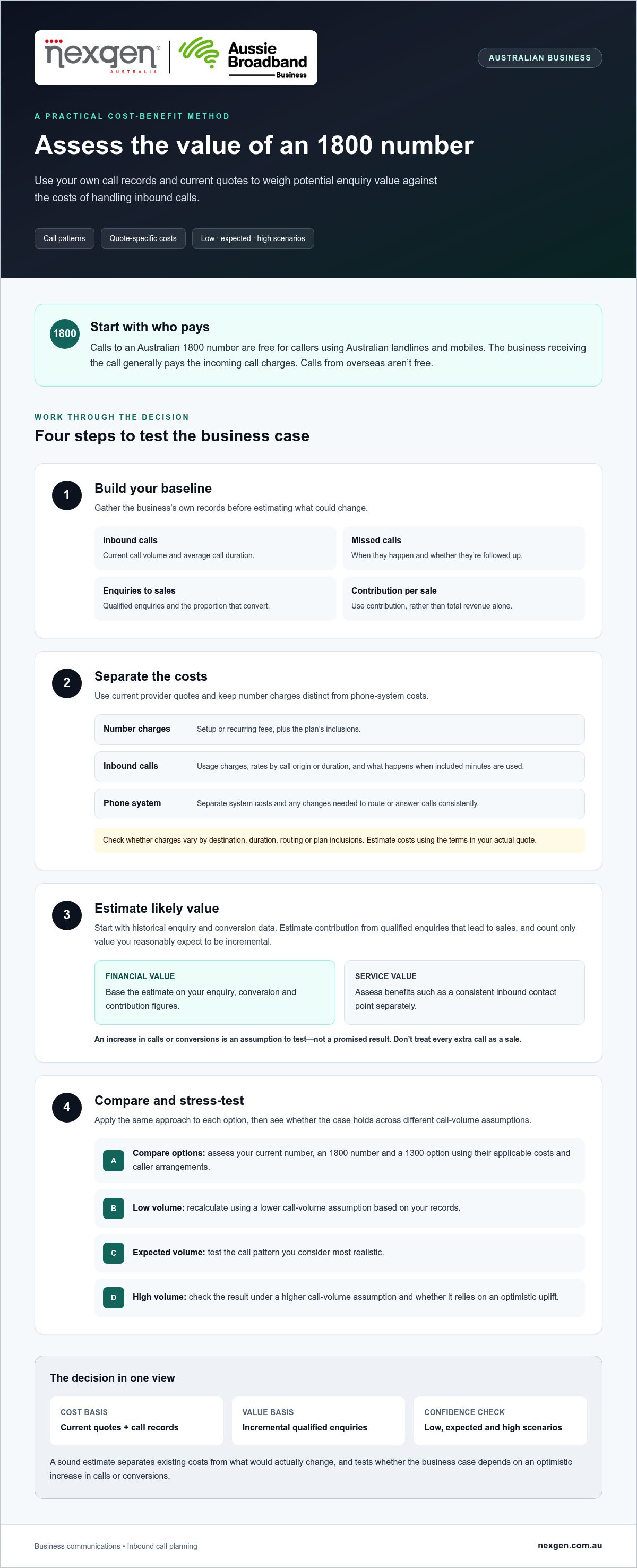
A practical decision framework for testing the business case
Use your audience, call records, quoted charges and call-handling setup to decide whether an 1800 number is worth testing. The business case is stronger when the number serves a clear purpose and the costs still make sense under cautious assumptions.
Work through these checks in order:
- Define the audience. Identify who is likely to call, where they’re calling from and whether removing a call charge matters to them.
- Set the purpose. Decide whether the number is intended for sales enquiries, customer service, support or another inbound need. Be clear about what a useful call outcome means.
- Establish likely volume. Use your records to estimate low, expected and high call volumes, including typical call duration and missed calls.
- Compare the costs with likely value. Apply the quoted charges to each scenario, then compare those costs with the estimated value of qualified enquiries and their outcomes.
- Check operational readiness. Map how calls will be answered, routed and followed up, and understand how the number service connects to your phone system.
Run a sensitivity check with your own call data
Use recorded call patterns and the quoted charge model to build the three scenarios. Label each assumption, including volume, average duration, conversion rate and contribution per sale. Then change one assumption at a time: a lower conversion rate or longer calls may shift the result, even if call volume stays steady. This shows which inputs matter most without relying on generic benchmarks.
Keep the comparison consistent. If you assess an existing number or a 1300 option alongside 1800, use the same audience, call purpose and enquiry-value method for each. Track call source, qualified enquiries and outcomes in the same way, so future results can be compared on a like-for-like basis.
Check operational fit before committing
Decide who answers calls, when they should route to different people or teams, and what happens when a call is missed. Then use provider information to understand how the number service connects to your existing phone system and whether it supports the planned call flow. A sound cost model won’t help if callers can’t reach the right person or their enquiry isn’t followed up.
Set a review point that fits your normal reporting cycle, such as the period when you already assess enquiries and sales outcomes. Compare actual call volume, duration, charges and results with your original scenarios. If the data differs, update the assumptions rather than treating the first estimate as a forecast.
A practical 1800 toll free number cost benefit analysis for australian business should make the decision clearer, not force a particular answer. Nexgen’s business phone systems can be considered as part of planning how your team handles calls.
Connect the 1800 number decision to a dependable business phone system
An 1800 number and a business phone system do different jobs. The number gives customers a way to call your business; the phone system manages what happens after the call arrives, such as where it rings and how your team handles missed calls. Assess both layers so a decision about caller access is matched by a practical call-handling plan.
Nexgen Australia provides business VoIP and cloud phone systems. These systems make up the phone-system layer, separate from the decision about which inbound number to use. The right arrangement depends on your team’s call flow, how staff work and the requirements of the number service you select.
What the phone system contributes to inbound call handling
Intelligent call routing is a phone-system capability, not an automatic feature of an 1800 number. It can direct incoming calls according to the configured call flow, helping businesses send enquiries to the appropriate person or team. Map the journey from the moment a customer calls to the point where someone answers or takes action.
If no one can answer immediately, voicemail-to-email can send voicemail messages to an email inbox to support follow-up. Desktop handset integration gives staff another way to handle business calls, while remote-work connectivity can help teams manage calls when they aren’t working from the office. These capabilities support call handling, but the process still needs clear ownership: decide who checks messages and how enquiries are followed up.
Plan the next step around the business requirement
Bring the decision back to four practical questions: Does the caller experience suit your audience? Do the quoted costs fit your call volumes? Does the likely value make sense against those costs? Can your phone system handle the calls and follow-up reliably? If one answer is uncertain, identify the missing information before committing to a change.
For example, a business expecting calls from customers across Australia may want a national inbound contact point, but it should also plan how enquiries will be distributed and who will respond. A business with a small team may need a clear route for unanswered calls as much as a suitable number. The system should reflect how your people work, including whether they use desktop handsets or handle calls remotely.
The number choice and phone system are separate decisions, but they need to work together in practice. Nexgen Australia can help plan the system side around your team’s call flow, with the inbound number choice and the system that manages calls treated as separate parts of the decision. Explore Nexgen Australia’s phone systems.
Turn your call strategy into a practical next step
Before making a change, write down what a successful inbound call should achieve for your business. That gives your team a clear point of reference for reviewing the 1800 toll free number cost benefit analysis for australian business and assessing whether the number and call-handling setup support the same goals.
Consider where callers need to reach, who should respond and how your team will follow up when a call can’t be answered straight away. Nexgen’s tailored business VoIP and cloud phone systems, including Cisco Webex Calling, can be part of that phone-system planning. Capabilities such as intelligent call routing and voicemail-to-email can help shape a consistent process for handling enquiries.
The number choice and phone system are separate decisions, but they need to work together in practice. If you’re ready to plan the system around your team’s call flow, talk to Nexgen about the right phone system for your business.
Frequently Asked Questions
Are 1800 numbers free to call from Australian mobiles?
Yes. Calls to Australian 1800 numbers are free for callers using Australian mobile phones. The business receiving the call pays the inbound call charges. This applies to calls made within Australia, not calls from overseas, which may incur international rates set by the caller’s phone provider. If you serve customers overseas, provide another contact option and avoid describing the number as free for every caller.
How much does an 1800 number cost an Australian business?
There’s no single cost for every business. Your total depends on the number service’s quoted setup or recurring charges, inbound call rates and any phone-system costs needed to manage calls. Review the plan inclusions and billing rules alongside your expected call volume and duration. For a useful estimate, base the calculation on your actual quote and call records rather than a generic price guide.
Can an 1800 number work with a VoIP phone system?
Yes, an 1800 number can work with a VoIP phone system when the number service is connected and configured for the system. The number provides the inbound contact point; VoIP manages how calls reach your team. The precise connection and routing depend on the number provider’s terms and the phone-system setup. Map the intended call flow, including where calls should go if the first person can’t answer.
Is an 1800 number better than a 1300 number for a small business?
Not automatically. An 1800 number removes call charges for Australian callers, while a 1300 number uses a shared-cost model, with mobile charges depending on the caller’s plan and carrier. The better fit depends on your audience, call patterns, quoted costs and the role of the number. A 1800 toll free number cost benefit analysis for australian business should compare these factors using your own records.
Can an Australian business keep its existing number as well as an 1800 number?
Generally, a business can keep using its existing number while adding an 1800 number, subject to the number services and phone-system configuration. The two numbers can serve different purposes, such as keeping an established contact point while using the 1800 number for a specific campaign or customer service line. Plan how calls to each number will be answered, and make it clear to customers which number best suits their enquiry.
What should a business measure after introducing an 1800 number?
Track more than the number of incoming calls. Record where enquiries came from, whether they were relevant, how many were answered or missed, and what happened after each conversation. Compare these results with a pre-launch baseline using the same definitions and reporting periods. Also review actual call charges against your estimate. This helps distinguish useful new enquiries from changes in call volume that don’t contribute to business outcomes.
Do 1800 numbers guarantee more customer calls?
No. Making a call free for Australian customers may reduce a cost barrier, but it doesn’t guarantee they’ll notice the number, choose to call or become customers. Results also depend on your audience, the reason to get in touch, how the number is promoted and how promptly enquiries are handled. Treat any expected increase as an assumption to measure after launch, not a promised outcome.