


A 1300 number won’t automatically make your small business look more established, and a local number won’t automatically make it seem more approachable. The right choice depends on who you serve and what your contact number signals to them. Choosing a 1300 number vs local number for small business credibility means weighing national reach against the reassurance of a familiar local presence.
Both options can support a professional image, but each suits a different customer footprint. A 1300 number can present your business as accessible across Australia, while a local number can reinforce its connection to a particular community. Neither one proves how established or responsive a business is.
This guide compares how each number may shape first impressions and customer access. It also explains how call handling contributes to the experience, so you can choose a number that fits your market and plan how enquiries reach your team.
Key Takeaways
- Credibility comes from choosing a number that fits the customers you serve, not from the prefix alone.
- Weigh national reach against a recognisable local presence when comparing number options.
- Map your customer locations and the impression you want your business number to make before deciding.
- Plan how calls will be routed, shared between team members and answered when staff work remotely.
- Match your number strategy to a phone system that can support your business as its needs change.
1300 Number vs Local Number: What Does Each Signal to Customers?
Credibility depends on customer fit, not the prefix alone. A number can shape a first impression, but it can’t prove that a business is established, delivers quality service or responds promptly. Those things become clear through the customer’s experience, from the first call to the way an enquiry is handled.
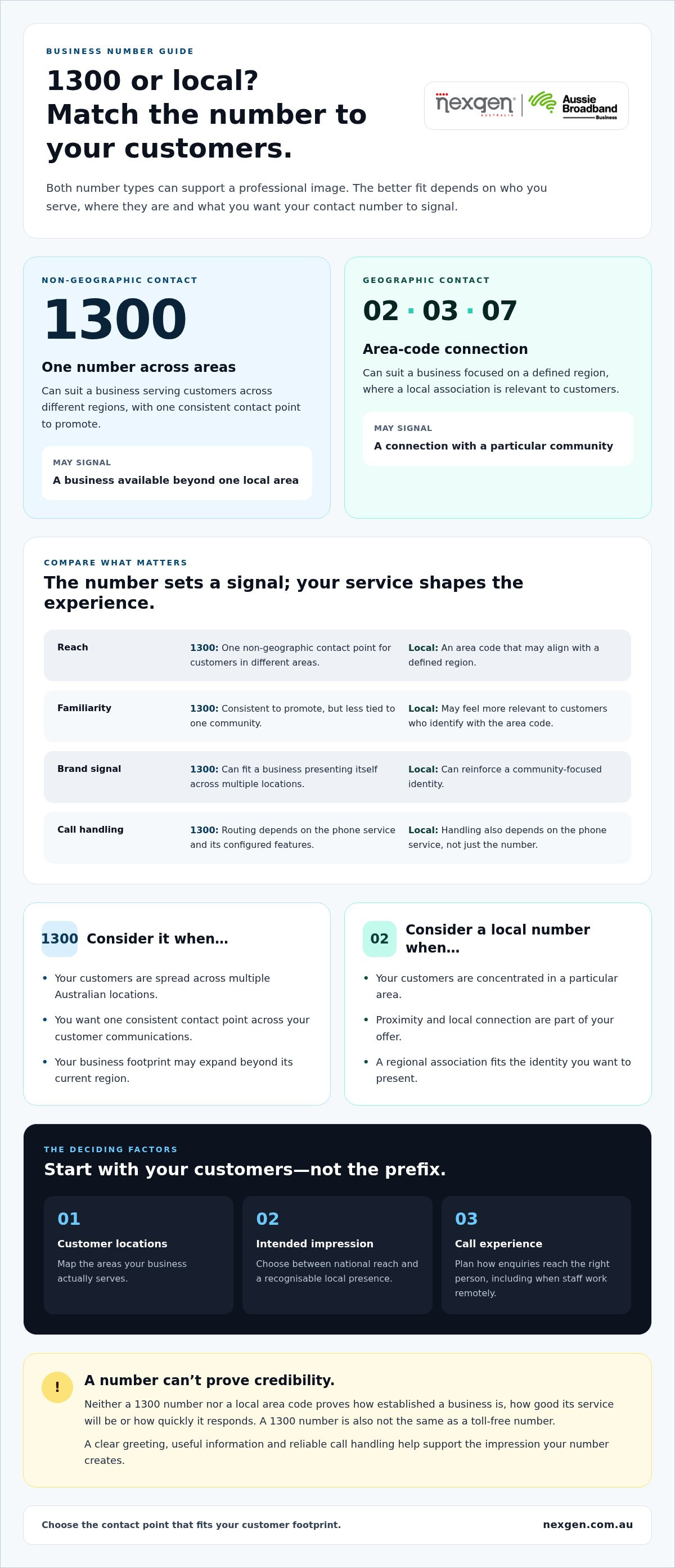
A 1300 number is a non-geographic Australian business contact number that isn’t tied to one local area. A local number is a geographic phone number associated with a particular area, commonly identified by an area code such as 02, 03 or 07. Each can suggest a different kind of business presence, but neither guarantees that customers will trust or choose the business.
Separate the signal from the service behind it. A clear greeting, useful information and calls reaching the right person all contribute to how professional a business feels. A well-chosen number can support that impression, but it can’t replace reliable call handling.
What customers may infer from a 1300 number
A 1300 number can suggest that a business serves customers beyond one local area. One contact point may also be simpler to promote when a business works across several regions, rather than using separate area-based numbers in its advertising.
That signal has limits. The number doesn’t establish how large the business is, where its staff are based or how good its service will be. A 1300 number also isn’t the same as a toll-free number: the general overview of toll-free telephone numbers describes a related but distinct category. The impression a number creates depends on the business and its customers.
What customers may infer from a local number
A local number can signal a connection with a particular geographic community. That may feel relevant to customers looking for a nearby service provider, such as a trades business serving a defined area or a practice whose clients are mainly local.
An area code doesn’t prove that a business is nearby, familiar or responsive. Customers may value local presence, but they’ll also judge the experience of contacting the business. A local number is most useful as a signal when it aligns with the areas the business actually serves.
In the 1300 number vs local number for small business credibility decision, consider what customers are likely to recognise and what your contact details need to communicate. A business serving customers across Australia may value a consistent, non-geographic contact point. A business focused on a particular community may prefer the local association of an area code.
Neither choice makes a business more professional by itself. Treat the number as one part of your customer-facing identity, then make sure the call experience supports the impression you want to create.
1300 Vs Local Numbers: Compare Reach, Familiarity and Customer Fit
Neither number type is automatically more credible. The better fit depends on where your customers are, what they expect from your business and how you’ll manage incoming calls. Use this comparison to weigh the likely benefits and limitations of each option.
| Consideration | 1300 number | Local number |
|---|---|---|
| Reach | Can provide one non-geographic contact point for customers across different areas. | Has a geographic area code and may align with a business serving a defined region. |
| Customer familiarity | May be less connected to a particular community, but offers a consistent number to promote. | May feel more relevant to customers who identify with the area code. |
| Brand signal | Can suit a business presenting itself as available across multiple locations. | Can reinforce a local, community-focused identity. |
| Operational fit | Call routing depends on the phone service and its configured features. | Call handling also depends on the phone service, not just the geographic number. |
These are possible impressions, not guarantees. A business contact number can contribute to a professional identity and local presence, as discussed in this overview of business phone number benefits. Customers also judge how clearly and reliably their enquiries are handled.
When a 1300 number may suit a small business
A 1300 number may suit a business serving customers across multiple Australian locations, or one expecting its footprint to expand. A single contact point across a website, advertising and other customer communications can make the business easier to identify, even when the team works in different places.
The number doesn’t route calls by itself. Routing depends on the phone service and the features configured for it. Consider the full cost of the arrangement, including any recurring service fees or charges linked to incoming calls.
When a local number may be the better fit
A local number may better match a business whose customers are concentrated in a particular area, especially when proximity is part of its offer. Its geographic identity can support a familiar, community-focused position without implying that every customer will recognise or trust the number.
If the business later serves customers nationally, an area code may continue to associate the number with its original region. That can still suit the brand, but consider how the number may appear to customers elsewhere.
One distinction matters: the number customers see is the contact point; the phone system determines how incoming calls are handled. Either number may work with a suitable system, but call distribution and other features depend on the service and its configuration. The 1300 number vs local number for small business credibility choice is about matching your customer footprint, not assuming one prefix delivers a better call experience.
If you’re planning how calls should reach your team, explore business phone system options alongside your number decision.
How to Choose a Business Number That Builds Credibility
Choose the number that reflects the customers you serve. Consider your customer locations, the impression you want to create, how calls are handled and where the business may be heading. This makes the 1300 number vs local number for small business credibility decision practical, rather than based on assumptions about which prefix looks more established.
Start with customer geography and brand positioning
Begin with your actual enquiries and customer base. Review where customers are located, which areas generate enquiries and whether people mainly choose you for a local service or an offer available across multiple areas. Your enquiry records and service areas can show whether your business is primarily local, national or spread across several regions.
Then decide what your contact details should communicate. A geographic number may support a locally focused identity, while a consistent national contact point may better fit a business serving customers in different areas. Align the number with the places you genuinely serve, not a footprint you hope to suggest.
Assess enquiry volumes and future growth
Consider the call experience separately from the number. Who answers incoming enquiries? What happens when that person is busy, away from the office or working remotely? These questions help you identify call-handling needs without assuming that a particular number type includes queues, routing or other phone-system functions.
Revisit the decision if your customer locations, team structure or contact needs change. A number that suited a locally focused business may be less aligned if it later serves customers across Australia. Equally, expansion doesn’t automatically make a local number unsuitable if local identity remains central to the business.
Use this four-step framework to reach a decision:
- Map your customers. Check where existing customers and enquiries come from. Decide whether your main audience is local, national or spread across several service areas.
- Define the brand signal. Decide whether local familiarity or one consistent contact point matters more to your customers. Choose an impression that accurately reflects your service footprint.
- Assess call needs. Identify who answers, how calls should reach the right person and what should happen during busy periods. Treat these as phone-system requirements, not benefits guaranteed by the number itself.
- Review future plans. Consider likely changes to your service areas, staffing and customer contact needs. Choose a number strategy that fits today and remains sensible if the business grows or changes direction.
For example, a business whose enquiries come mainly from its local service area may prioritise a geographic identity. A business handling enquiries from customers across several regions may value one consistent number in its communications. Neither scenario makes one choice universally better. Choose the option customers can understand and that your call-handling arrangements can support.
Connect Your Number Choice to a Better Call Experience
Your business number and phone system do different jobs. The number is what customers dial; the phone system manages where the call goes and how your team answers. That distinction matters in the 1300 number vs local number for small business credibility decision: either number can be a useful front door, but the system behind it shapes the call experience.
Picture a customer calling the number on your website. The call needs to reach someone who can help, whether that’s a receptionist, a particular team or a staff member working away from the office. A consistent public number can connect callers to the right people across different devices when the phone service is configured to support that call flow.
Plan how incoming calls reach the right person
Map the journey from dialling to answer. Identify who should receive each type of call, how calls should reach the team when someone is unavailable and what staff need to handle enquiries during busy periods. This helps you define call-handling requirements independently of the number customers see.
Intelligent call routing and flexible call handling can help direct incoming calls as team needs change. The setup depends on the phone system and its configuration, so don’t assume that a 1300 or local number automatically includes a particular feature. Focus on the customer journey you want to support.
Make the number work with a scalable phone system
Cloud phone systems can support teams working across locations, while VoIP lets people make and receive business calls over an internet connection. Consider how staff need to answer calls across the office and remotely, and whether the system can accommodate multiple users as roles or team arrangements change. Explore small business phone systems and cloud communications when planning how your team will manage calls.
The number shapes your business’s contact identity; the phone system determines how calls are handled. Keeping those roles distinct makes it easier to compare options and avoid expecting the number itself to solve staffing or call-management challenges.
Before settling on a setup, write down a simple call path: the customer dials, the call reaches the intended person or team, and another suitable team member can respond if needed. Then consider which devices staff use and whether they need to answer while away from the office. This gives you a practical basis for planning call routing, remote connectivity and flexible call handling.
Nexgen Australia provides tailored business VoIP and cloud phone systems across desk phones, computers and mobile devices.
Choose a Number Strategy That Fits Your Business Phone System
Choose a number that reflects the customers you serve, then plan how your phone system will handle their calls. A local number can suit a business focused on a specific community, while a 1300 number may better fit a business serving customers across different areas. Neither choice replaces the need for a clear, well-managed call experience.
The 1300 number vs local number for small business credibility decision is about the contact identity you want customers to see. The phone system is a separate consideration: it supports the movement of calls to the people who need to answer them. Keeping these decisions distinct helps you compare number options without assuming the prefix itself determines how calls are handled.
How Nexgen can support the phone-system side of the decision
Nexgen provides small business phone systems and tailored VoIP and cloud communications for Australian businesses. Flexible call handling and intelligent call routing can be planned around your team’s requirements and customer contact number, helping calls reach the appropriate people as work arrangements change.
Nexgen also deploys Cisco Webex Calling across desk phones, computers and mobile devices, supporting teams that need to connect using different devices.
Prepare for a practical conversation about your requirements
A useful discussion starts with how your business operates. Note where customers are based, what kinds of enquiries come in and who needs to answer them. Then outline current challenges, such as calls reaching the wrong person or staff needing to stay connected while working remotely.
Describe likely changes too, such as serving new areas, adding team members or changing how enquiries are managed. This keeps the phone-system discussion focused on how calls should move through your business now and how the setup may need to adapt.
Before discussing a system, prepare a short list of requirements:
- Customer footprint: where your customers are and which areas your business serves.
- Call responsibilities: who answers different enquiries and who can help when the usual contact is unavailable.
- Working arrangements: which team members need to handle calls in the office or remotely.
- Expected changes: any planned shifts in team structure, service areas or customer contact needs.
These details connect your number strategy to a suitable call-handling approach. Nexgen’s business phone systems, VoIP and cloud communications can be tailored to your operational requirements, with call handling planned around the contact number your business uses.
Make Your Contact Strategy Ready for What’s Next
Your business number is part of how customers find and contact you, so it should continue to make sense as your customer base and team evolve. Review it when you expand your service areas, change how enquiries are managed or adjust your team’s working arrangements. Consider whether the number still reflects your business and whether the call experience supports it.
The right choice in the 1300 number vs local number for small business credibility decision isn’t about appearing larger or more local than you are. It’s about making a clear, credible connection with the people you serve, then ensuring your communications setup supports the way your business works.
With a clear view of your requirements, you can plan the phone-system side with confidence. Nexgen works with Australian businesses on tailored VoIP and cloud communications, including systems designed around practical call-handling needs.
Talk to Nexgen about a phone system that fits your business and plan a contact experience that can grow with your team.
Frequently Asked Questions
Is a 1300 number more credible than a local number?
No. Neither number is inherently more credible. The question of 1300 number vs local number for small business credibility has no universal winner because customers may value different signals. Use your contact number consistently on your website, invoices and business profiles, and make sure your greeting clearly identifies the business.
Can a small business have both a 1300 number and a local number?
Some businesses use more than one contact number, depending on their number service and phone-system setup. If you use both, give each a clear purpose, such as one for national advertising and the other for local enquiries. Keep a record of where each is published and how calls are answered. Charges and routing options depend on the number arrangement and phone service.
How much does a 1300 number cost for a small business?
There isn’t one price that applies to every 1300 number arrangement. Costs may include setup, recurring service fees or charges linked to incoming calls, and can vary with the arrangement and call patterns. Compare the full cost, not just a monthly fee, and consider how expected call volumes fit your business budget.
What happens if my business moves after choosing a local number?
A move may make the geographic identity of a local number less aligned with your business, but the effect depends on the number and service arrangement. Plan how you’ll update your website, invoices and business listings so customers can find the right contact details during the change.
Does a 1300 number mean customers can call my business for free?
No. Don’t assume every caller can reach a 1300 number for free. The caller’s cost may depend on their phone plan and provider, and the business may also have charges for receiving calls. Avoid describing calls as free unless that claim is accurate for the callers you’re addressing.
Can I use a 1300 number with a cloud phone system?
Compatibility depends on the number service, phone provider and system configuration. Start by outlining the call path you need, such as which team should answer and how calls should reach staff working remotely. VoIP and cloud phone systems handle business calls over an internet connection.